
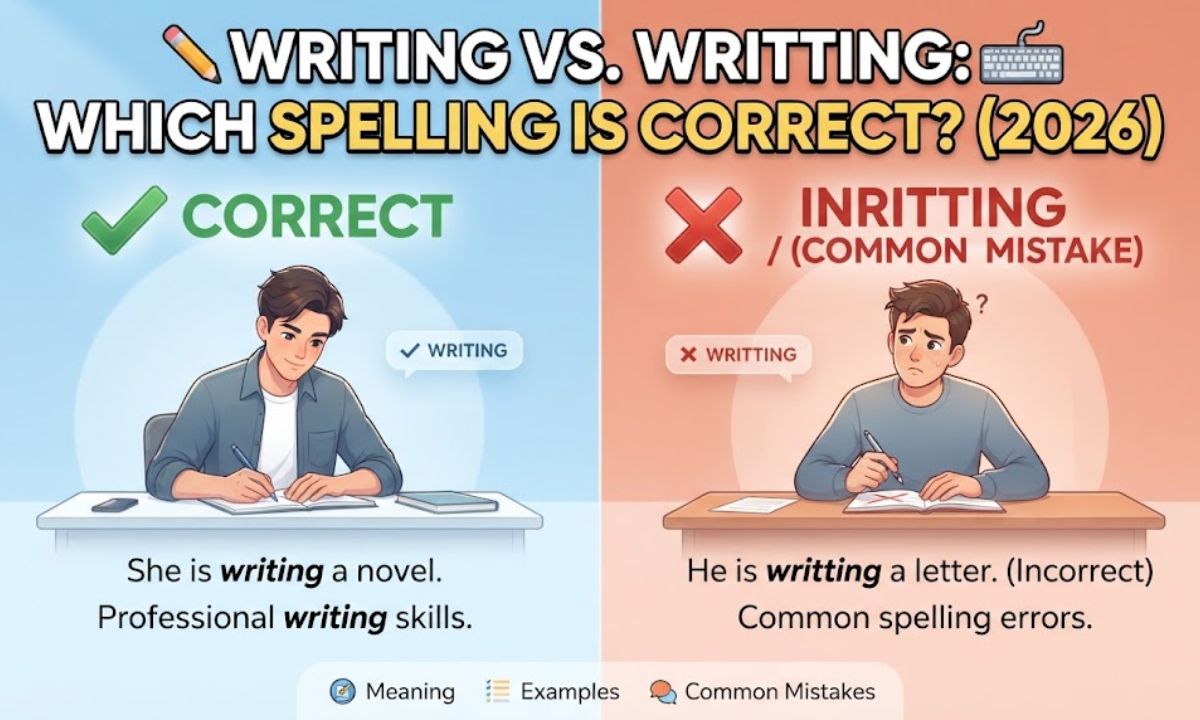

If you’ve ever typed a sentence and paused, wondering whether it’s “I am writing” or “I am writting,” Actually Writing vs Writting you’re not alone. This is one of the most searched spelling questions in English, and the confusion makes complete sense once you understand why it happens. The good news? There’s only one correct answer, and once you learn the simple rule behind it, you’ll never second-guess yourself again.
Writing or Writing – Which Is Correct?
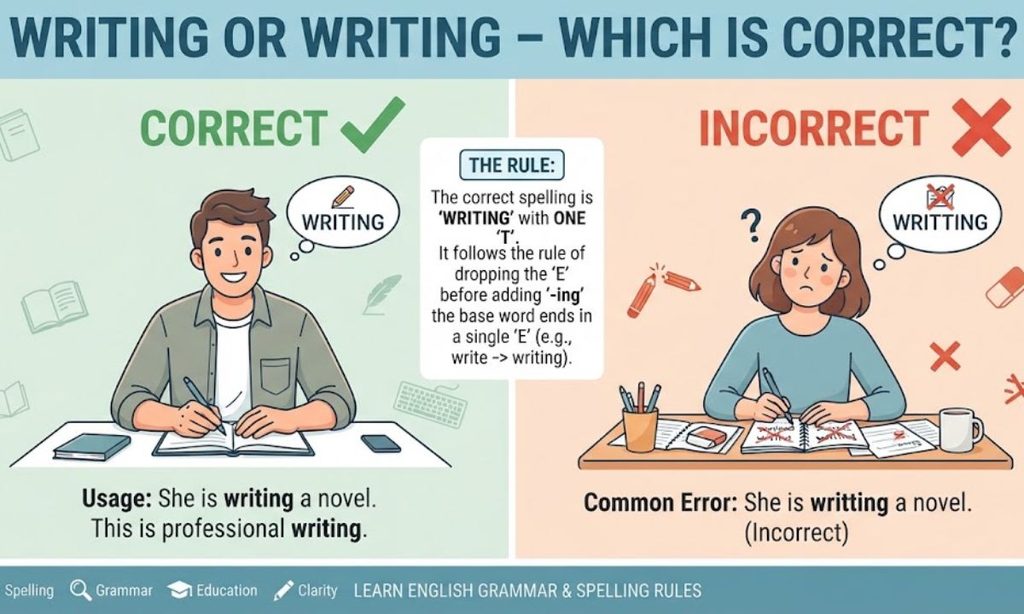
The correct spelling is writing — with a single “t.” The word writting (double “t”) is always incorrect. It doesn’t appear in any dictionary, style guide, or accepted form of standard English, no matter how natural it might feel to type.
This isn’t a matter of British vs. American English either. Writing is spelled the same way everywhere in the English-speaking world.
Why “Writing” Has One T: The Rule That Solves It
The confusion comes from a clash between two different English spelling rules:
- The silent “e” dropping rule – applies to write
- The consonant doubling rule – applies to words like run and sit
Write ends in a silent “e,” so rule #1 applies, not rule #2. That’s the entire mystery solved in one sentence.
The Silent E Dropping Rule (Drop the Silent E Before Adding -ING)
Here’s how it works: when a verb ends in a silent “e,” you drop that “e” before adding “-ing.”
| Base Verb | +ING Form |
| write | writing |
| make | making |
| ride | riding |
| hope | hoping |
| take | taking |
Notice the pattern? The “e” disappears, but the consonant before it stays single. That’s exactly what happens with write → writing.
When Do We Double Consonants in English?
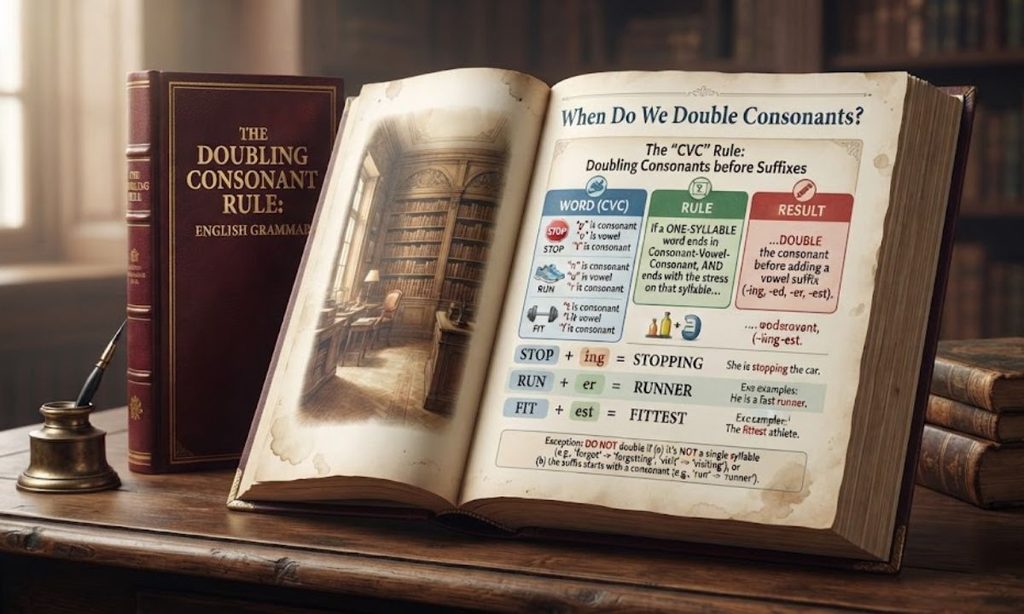
Consonant doubling is a separate rule, and it only applies under specific conditions — usually when a short vowel sound is followed by a single consonant at the end of a one-syllable word.
| Base Verb | +ING Form | Why It Doubles |
| sit | sitting | short vowel + single consonant |
| run | running | short vowel + single consonant |
| hit | hitting | short vowel + single consonant |
| stop | stopping | short vowel + single consonant |
The key difference: these words have a short vowel sound, while “write” has a long vowel sound (the “i” sounds like “eye,” not a short “ih”). That long vowel sound is a signal that the doubling rule doesn’t apply.
Write → Writing Rule Explained Clearly
Putting it all together, here’s the exact transformation:
- Start with write
- Drop the silent “e” → writ
- Add -ing → writing
No doubling needed. No extra “t.” Just one clean, simple swap.
Why “Writing” Looks Right (But Isn’t)
Writting feels intuitive because your brain is pattern-matching against words like sitting, hitting, and fitting. Since those words double their final consonant, it seems logical that write should follow suit.
But English spelling isn’t purely about sound — it’s about vowel length and word structure. Because write has a silent “e” and a long vowel sound, it belongs to a completely different spelling family than sit or hit.
Also read this REQUESTOR VS REQUESTER MEANING
Forms of the Verb “Write” (Know Them All)
Understanding every form of “write” helps prevent related spelling mistakes down the line.
| Tense/Form | Word | Example |
| Base form | write | I write every morning. |
| Present participle | writing | She is writing a novel. |
| Past tense | wrote | He wrote a letter yesterday. |
| Past participle | written | The book was written in 1990. |
| Third person singular | writes | He writes clearly. |
Writing vs Writting Examples
- ✅ I love writing short stories.
- ❌ I love writting short stories.
- ✅ She is writing her thesis.
- ❌ She is writting her thesis.
Writing vs Writting Grammar
Grammatically, only “writing” functions as a valid present participle or gerund. “Writting” has no grammatical role because it isn’t a recognized word — it’s simply a misspelling with no dictionary entry or grammatical function.
Writing Spelling Words (Similar Patterns)
Words that follow the same “drop the silent e” pattern as writing include:
- believe → believing
- give → giving
- live → living
- drive → driving
- love → loving
Spelling Words in English (Quick Memory List)
- write → writing
- come → coming
- hope → hoping
- smile → smiling
- shine → shining
Difference Between Writing and Written

People often confuse writing and written because both come from the same base verb, but they serve different grammatical purposes.
| Feature | Writing | Written |
| Type | Present participle / gerund | Past participle |
| Used with | am/is/are (continuous tense) | has/have/was/were (perfect or passive) |
| Example | I am writing an email. | The email has been written. |
| Spelling pattern | One “t” | Double “t” |
Notice that written does have a double “t” — but that’s a completely different grammatical transformation (an irregular past participle), not the same -ing rule that trips people up with “writing.”
Writing Examples in Sentences
- I am writing a report for my manager.
- She enjoys writing poetry in her free time.
- We were writing notes throughout the lecture.
- Thank you for writing to us regarding your concern.
- Good writing requires practice and patience.
Where This Mistake Causes Real Damage
A single misplaced letter might seem trivial, but in certain contexts, it can genuinely hurt your credibility.
Professional Email Writing
Imagine opening a job application with: “I am writting to express interest in this position.” That one typo, right in the opening line, can make a hiring manager question your attention to detail before they’ve even read your qualifications.
Academic Writing
In essays, research papers, or theses, spelling errors like “writting” can lower grades or reduce the perceived credibility of otherwise strong arguments.
Business Communication
Proposals, client emails, and reports all rely on polished language. A basic spelling mistake in business writing can quietly undermine trust, even if the content itself is solid.
Common Reasons for This Spelling Error
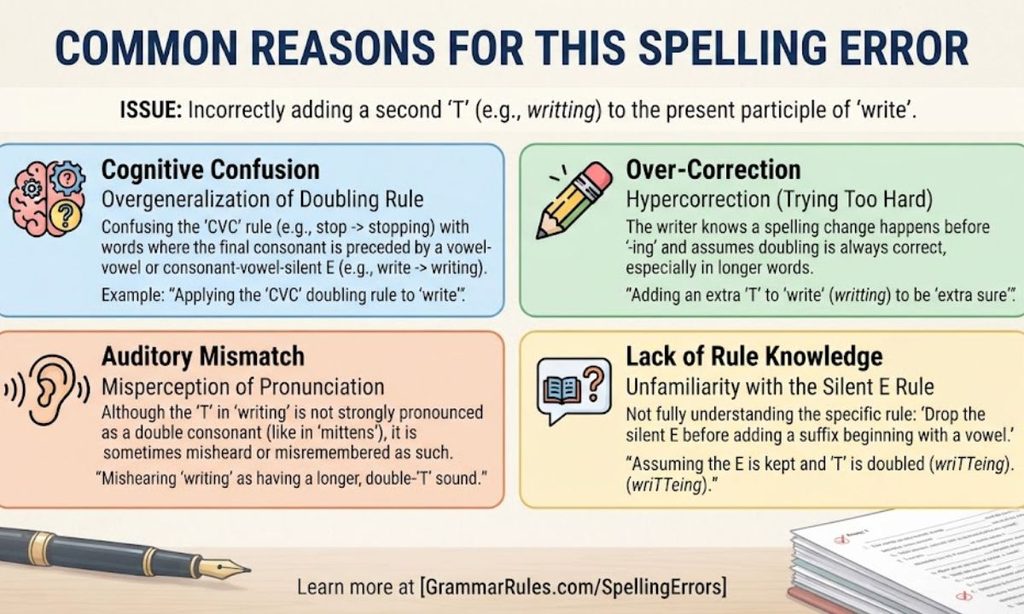
- Overgeneralizing the consonant-doubling rule from words like sitting and hitting
- Typing quickly without reviewing the word
- Relying on how the word sounds rather than how it’s spelled
- Limited exposure to the silent “e” dropping rule during early English learning
- Autocorrect inconsistencies on certain devices or keyboards
Case Study: Real-World Writing Correction
Before (Incorrect): “Thank you for writting to us. We appreciate your feedback.”
After (Correct): “Thank you for writing to us. We appreciate your feedback.”
That single extra letter changes how professional and polished the message appears — proof that one small correction can shift the entire tone of a message.
How to Spell Writing Without Thinking Twice
Try this simple mental trick: picture the word “write,” physically cross out the “e,” and tack on “-ing.” If you visualize that two-step process each time, the correct spelling becomes automatic.
Another trick: remember that “write” has a long vowel sound (like “eye”), and long-vowel words almost never double their final consonant before “-ing.”
Correct vs Incorrect Spelling Breakdown
| Correct | Incorrect |
| writing | writting |
| written | writen |
| writer | writter |
| rewriting | rewritting |
What About “I Am Writing” or “Writing”?
Both “I am writing” and standalone “writing” (as a noun or gerund) follow the exact same single-t spelling. There is no version of this word, in any tense or usage, that legitimately takes a double “t” in the -ing form.
Writing in English: Why Spelling Precision Matters
English spelling often feels inconsistent, but small rules like this one exist for a reason: they keep written communication clear and standardized. Precision in spelling isn’t about perfectionism — it’s about making sure your message is taken seriously.
Grammar Tips for Writing Clearly
- Always double-check silent “e” verbs before adding “-ing”
- Read your sentence aloud to catch awkward or incorrect phrasing
- Use a grammar checker as a second layer of review, not a replacement for learning the rule
- Keep a personal list of tricky spelling words you tend to misspell
Writing Skills Improvement Strategy
- Read regularly to absorb correct spelling patterns naturally
- Practice writing short paragraphs daily
- Review and edit your own work before submitting it
- Study common English spelling rules (silent e, doubling, plurals)
- Ask for feedback from teachers, colleagues, or editors
1. “Writing or Writing – Which Is Correct?
“ This is the exact-match query driving most searches. People aren’t searching for grammar theory — they’re typing this phrase directly into Google when they’re mid-sentence and unsure. This needs to be answered in the first 1–2 sentences of your article (ideal for the featured snippet box).
2. “Why does ‘write’ not double the T like ‘sit’ → ‘sitting’?
“ This is the reasoning search — people who already know “writing” is correct but want to understand why, usually because they’re comparing it to similar words (sitting, hitting, running). This is the silent-e vs. consonant-doubling rule, and it’s what keeps people reading past the first answer instead of bouncing.
Quick Reference Snapshot
| Question | Answer |
| Correct spelling? | Writing |
| Incorrect spelling? | Writing |
| Rule that applies? | Drop silent “e” before -ing |
| Vowel sound in “write”? | Long vowel |
| Used in formal English? | Yes, “writing” only |
Frequently Asked Questions
Is “writing” ever correct in any English dialect?
No. “Writting” is not accepted in British, American, or any other standard form of English.
Why doesn’t “write” double its final consonant like “sit” does?
Because “write” has a long vowel sound and ends in a silent “e,” while “sit” has a short vowel sound — different rules apply to each.
What is the past participle of “write”?
The past participle is “written,” which does correctly use a double “t” as part of its irregular form.
Does autocorrect always catch “writting”?
Not always. Some keyboards and apps miss it, especially in casual typing, so manual proofreading still matters.
Is “writing” a noun or a verb?
It can be both — a present participle (verb form) as in “I am writing,” or a gerund/noun as in “Writing is a valuable skill.”
Final Thoughts: Writing Wins Every Time
The rule is simple once it clicks: drop the silent “e” in write, add “-ing,” and you get writing — no doubling required. “Writting” may look plausible at a glance, but it has no place in correct English. Whether you’re drafting an email, an essay, or a business proposal, remembering this one rule will help you spell it right every single time.
