
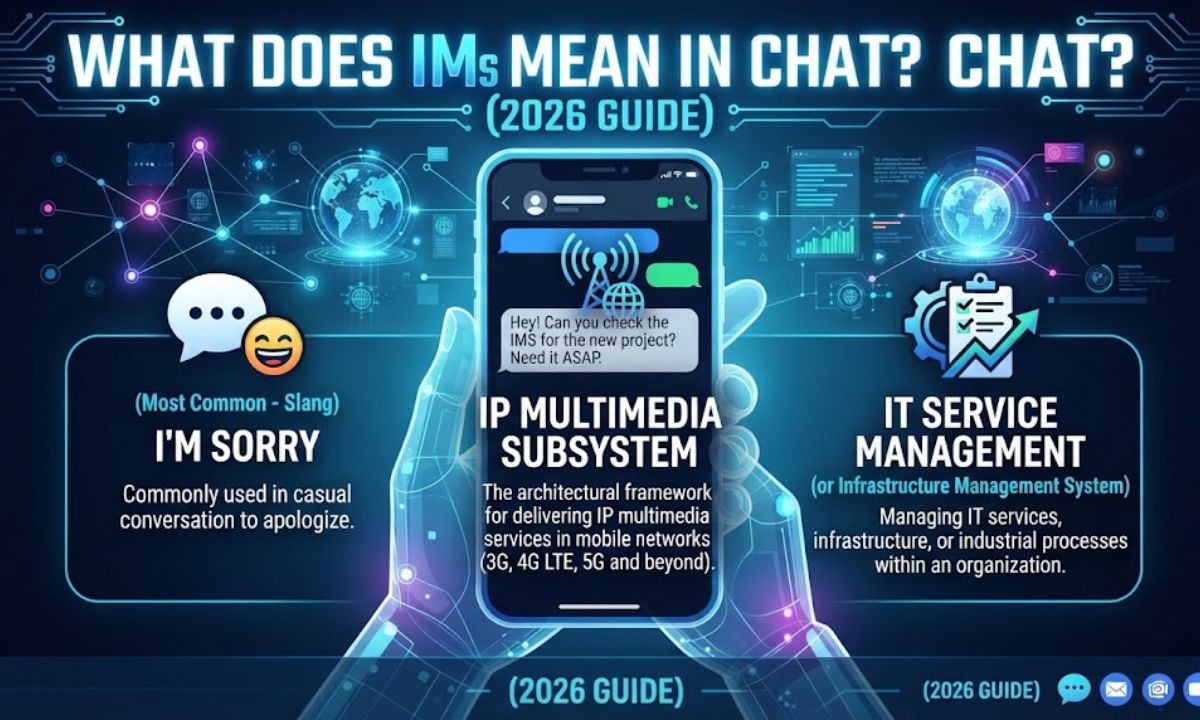

Someone just texted you “IMS,” and now you’re trying to decode the vibe. Is it sweet? Is it an apology? Or is it just three random letters?
Don’t worry. You’re not alone. Slang changes fast, and even regular texters get stuck on new abbreviations.
This guide explains the IMS meaning in text in plain words. You’ll learn what it means from a girl, what it means from a guy, how to read “ims u,” “ims yu,” and “ims sum,” and how to reply without any awkwardness.
What Does IMS Mean in Text? (Quick Answer)
IMS in text most often means “I miss…” It usually comes right before a word like “u,” “yu,” “sum,” or a person’s name. So “ims u” means “I miss you.”
In some chats, a lone IMS can also mean “I am sorry.” The words around it tell you which meaning is right.
| IMS Version | Meaning | Tone |
| ims u / ims yu | I miss you | Sweet, caring |
| ims sum | I miss some (people, things) | Casual, nostalgic |
| ims + a name | I miss that person | Warm, personal |
| ims (alone, after a mistake) | I am sorry | Apologetic |
| ims (alone, late at night) | I miss you / I miss us | Emotional |
Remember this rule: look at the message before and after IMS. That one habit solves almost every confusing case.
Simple Meaning: Breaking It Down in Plain Words
IMS is a short form. People use short forms because typing takes time, and feelings come fast.
Here’s the breakdown:
- I = I
- M = Miss (or “am”)
- S = Sorry, “so,” or “some”
That’s why the same three letters can carry two different messages. One is about longing. The other is about guilt.
Think of it like the word “bat.” A bat can be an animal or a cricket bat. You only know which one when you see the sentence.
The Two Main Meanings at a Glance
- I miss (you / someone / something). This is the most common reading when “u,” “yu,” or “sum” follows it.
- I am sorry. This shows up when the sender is replying to a mistake, a late reply, or an argument.
Both are casual. Both are used between people who already know each other.
Is IMS Official Slang?
IMS is informal chat shorthand. You won’t find it in a formal dictionary. It grows from how people text, much like “imy,” “omw,” or “brb.”
Because it’s informal, its meaning can shift between friend groups. That’s normal for slang.
Where Is “IMS” Used?
You’ll mostly spot IMS in relaxed, fast conversations. It rarely shows up in formal emails or work documents.
Common places include:
- Snapchat chats and replies
- Instagram DMs and story replies
- WhatsApp and iMessage threads
- TikTok comments and captions
- Discord and gaming chats
- Quick replies between close friends, couples, and family members
It fits best where people type fast, use emojis, and don’t worry about perfect grammar.
IMS on Social Media
On Instagram and TikTok, you’ll often see it in comments. A fan might write “ims u” under an old video of a creator. A friend might write “ims” under a throwback photo.
On Snapchat, it often appears in quick chat replies. The meaning is usually “I miss you.”
IMS Outside of Texting
Outside chat, IMS stands for several serious things. Examples include Information Management System and Inventory Management System. These are tech and business terms.
If you see IMS in an office email or a software manual, it’s likely one of these. In a text from a friend, it’s almost never that.
Why Do People Use “IMS”?
Slang exists for reasons. People don’t type “ims” just to look cool.
Here are the main ones:
- Speed. Three letters are faster than three words.
- Comfort. It feels softer than a long, serious message.
- Low pressure. Saying “I miss you” can feel heavy. “ims u” feels lighter and safer.
- Habit. Chat culture loves shortcuts. Once you see “imy” and “omw,” “ims” feels natural.
- Testing the waters. Some people use it to show feelings without going all in.
That last point matters. A short message lets someone say something real while keeping an easy exit. If the other person reacts coldly, they can just say, “lol I was joking.”
The Psychology Behind Short Messages
Short texts feel less risky. A full sentence like “I really miss you and I wish we could meet” is a big step. “ims u” is a small step.
So when someone sends IMS, they may feel more than the word suggests. Don’t ignore it just because it’s short.
Real-Life Examples of “IMS” in Action
Examples make slang easy to understand. Here are common situations.
Example 1: Missing a friend
- “ims u, we need to hang out soon”
- Meaning: I miss you. We need to hang out soon.
Example 2: Missing a group
- “ims sum people from school lol”
- Meaning: I miss some people from school.
Example 3: A quick apology
- “ims, I forgot to reply”
- Meaning: I am sorry. I forgot to reply.
Example 4: With an emoji
- “ims yu 🥺”
- Meaning: I miss you, with a soft, sad feeling.
Example 5: Long-distance partner
- “ims so much, counting the days”
- Meaning: I miss you so much. I’m counting the days.
Example 6: After a fight
- “ims, didn’t mean to say that”
- Meaning: I am sorry. I didn’t mean to say that.
Notice how the second half of each message gives the answer. That’s the trick.
IMS Meaning in Text From a Girl
When a girl texts “ims u,” she most likely means she misses you. How deep that goes depends on your relationship.
- From a close friend: friendly and warm.
- From a partner: affectionate and caring.
- From a crush: a hint that she’s thinking about you.
Look for extra clues:
- Emojis like 🥺, ❤️, or 😔 add warmth.
- Late-night timing often means deeper feelings.
- A plain “ims” right after an argument may be an apology.
- A quick “ims u” in a group chat is usually just friendly.
Don’t read too much into one message. Read the pattern over time.
IMS Meaning in Text From a Guy
Guys often keep texts short. So “ims” from a guy may look blunt, but the meaning is the same.
- “ims u” = he misses you.
- “ims” after a mistake = he’s saying sorry.
- “ims sum” = he’s casually missing something or someone.
If he rarely shares feelings by text, an “ims u” can mean more than it seems. A short message from a quiet person can be a big step.
IMS U Meaning in Text
“IMS u” means “I miss you.” The “u” is just a short way to write “you.”
It’s one of the clearest uses of IMS. You can reply with “miss you too” or “imy too.”
IMS YU Meaning in Text
“IMS yu” also means “I miss you.” The “yu” spelling is a casual, typo-style version of “you.”
Some people type it that way to sound cute or relaxed. It doesn’t change the meaning.
IMS SUM Meaning in Text
“IMS sum” means “I miss some…” The “sum” stands in for “some” as in some people, some places, or some moments.
It often shows up when someone feels nostalgic. For example: “ims sum old days.” That means “I miss some old days.”
IMS vs Similar Terms
IMS has many cousins in the texting world. Here’s how they compare.
| Slang | Full Form | Best Used For |
| IMS | I miss… / I am sorry | Casual chats with context |
| IMY | I miss you | Clear and direct |
| IMYSM | I miss you so much | Strong emotion |
| IMU | I miss you | Quick, casual |
| MU | Miss you | Very short replies |
| SRY | Sorry | Simple apology |
| IMSG | Instant message | Messaging apps |
| ILY | I love you | Deeper affection |
The main difference is clarity. IMY always means “I miss you.” IMS can mean two things, so it depends on context.
If you want zero confusion, pick IMY for missing someone and SRY for apologizing.
IMS vs IMSG
People often mix these up. IMSG usually points to “instant message.” IMS is about feelings, either missing or apologizing.
So “send me an imsg” means “send me a message.” But “ims u” means “I miss you.”
IMS vs IMY
IMY is more direct. Everyone reads it as “I miss you.” IMS is shorter and softer, but less certain.
Use IMS when the context is already clear. Use IMY when you want to be certain.
When Should You Use “IMS”?
Use IMS when the mood is relaxed and the other person knows your texting style.
Good times to use it:
- Texting a close friend you haven’t seen for a while
- Replying to your partner during a busy day
- Apologizing for a small slip, like a late reply
- Sending a quick, sweet message to family
- Commenting on a throwback photo or video
Times to skip it:
- Writing to a boss, teacher, or client
- Apologizing for something serious
- Texting someone who doesn’t use slang
- Starting a first message with a new person
For big apologies or deep feelings, type the full sentence. It shows effort. A short “ims” after a serious mistake can feel lazy.
Is It Okay to Use IMS in a Relationship?
Yes, it’s fine. Many couples use short forms every day. Just make sure the feeling behind it is real.
If your partner is upset, don’t hide behind an acronym. Say the whole thing: “I’m sorry I hurt you.” That small change matters a lot.
Common Misunderstandings About “IMS”
A few mix-ups happen again and again. Let’s clear them up.
- Myth: IMS always means “I miss you.” Not true. It can also mean “I am sorry.”
- Myth: IMS is the same as IMSG. No. IMSG usually means “instant message.”
- Myth: IMS is always romantic. Wrong. Friends, siblings, and cousins use it too.
- Myth: IMS has one official meaning. It doesn’t. Slang changes by group, app, and region.
- Myth: IMS is a tech term in chat. In texting, it’s slang. In offices and software, IMS can stand for systems like Information Management System.
Why the Confusion Happens
Slang spreads by word of mouth and screenshots. Nobody controls it. So two people can use the same acronym for two different things.
That’s normal. The best fix is simple: check the context, and ask if you’re unsure.
Red Flags That Change the Meaning
Watch for these:
- If the message follows an argument, think “sorry.”
- If it follows a long silence, think “miss.”
- If it’s followed by “u” or “yu,” think “miss you.”
- If it’s followed by “for that” or “about it,” think “sorry.”
These tiny clues almost always point you in the right direction.
Pro Tips for Using “IMS” Correctly
Want to use IMS without causing confusion? Try these simple tips.
- Add a clear word. “ims u” is much clearer than “ims.”
- Use an emoji. A ❤️ or 😔 shows the tone right away.
- Know your audience. Slang works with friends, not with strangers.
- Don’t overuse it. Mix short forms with full sentences.
- Match the mood. Use light slang for light moments only.
- Ask if you’re lost. “Wait, do you mean miss or sorry?” is a perfectly fine question.
- Be honest. Don’t use it as a quick way to dodge a real talk.
How to Reply to “IMS”
Your reply should match the meaning you think it carries.
If it means “I miss you”:
- “imy too”
- “miss you more”
- “let’s catch up soon”
If it means “I am sorry”:
- “it’s okay”
- “all good, no worries”
- “thanks for saying that”
If you’re not sure:
- “ims what? 😄”
- “miss me or sorry?”
A playful question works well. It keeps the chat light and clears the confusion.
Texting Etiquette Tips
Good slang use is about kindness, not speed. Keep these in mind:
- Don’t use slang to avoid a serious talk.
- Don’t mock someone who doesn’t understand a term.
- Respond within a reasonable time when someone says they miss you.
- Be clear when emotions are involved.
These habits make you a better texter, no matter which acronyms you use.
Why Slang Like IMS Keeps Growing
Texting started with tiny keypads and limited characters. People made short forms to save time. Even though phones are faster now, the habit stuck.
Today, slang is also about identity. Using the right words shows you belong to a group. It makes chats feel friendly and relaxed.
New acronyms appear all the time. Some last for years. Others fade in months. IMS may stay a small, casual piece of chat language, used mostly between people who are close.
Will IMS Become More Popular?
Nobody can say for sure. But short emotional texts like “imy” and “ims u” are very natural to people. As long as people want quick ways to say they care, forms like IMS will stick around.
Final Thoughts
IMS is a tiny acronym with a flexible meaning. Most of the time, “ims u” simply means “I miss you.” Other times, a lone “ims” means “I am sorry.”
Read the message. Check the mood. Look at the timing. Then reply with kindness.
Next time someone texts you “IMS,” you’ll know exactly what to say. And if you’re ever unsure, a quick, friendly question is always better than a wrong guess.
FAQ Section
What does the IMS stand for?
In texting, IMS usually stands for “I miss…” and sometimes “I am sorry.” The surrounding words show which one it is.
What is IMS in messaging?
In messaging, IMS is casual shorthand to say you miss someone or you’re sorry. It’s mostly used between friends, partners, and family.
What does “ims sum” mean in text?
“Ims sum” means “I miss some…” such as people, places, or old moments. It’s a relaxed way to show you’re feeling nostalgic.
What does “ims yu” mean in text?
“Ims yu” means “I miss you.” The “yu” is just a casual spelling of “you.”
What does “ims u” mean in text?
“Ims u” means “I miss you.” It’s one of the most common and clearest uses of IMS.
Is IMS rude to send?
No, it isn’t rude. It’s friendly slang, but it’s best used with people who know you well.
Can IMS be romantic?
Yes. From a partner or crush, “ims u” can be a sweet way to show affection. Tone and timing make the difference.
What is the difference between IMS and IMY?
IMY always means “I miss you.” IMS is less clear and can also mean “I am sorry.”
How do I reply to IMS?
If it means “I miss you,” reply with “imy too” or “miss you more.” If it means “I am sorry,” say “it’s okay” or “no worries.”
Does IMS mean “I am sorry” on Snapchat?
It can, but “I miss you” is more common when “u” or “yu” follows. Check the context of the chat.
Is IMS the same as IMSG?
No. IMSG usually means “instant message,” while IMS is about feelings like missing or apologizing.
