
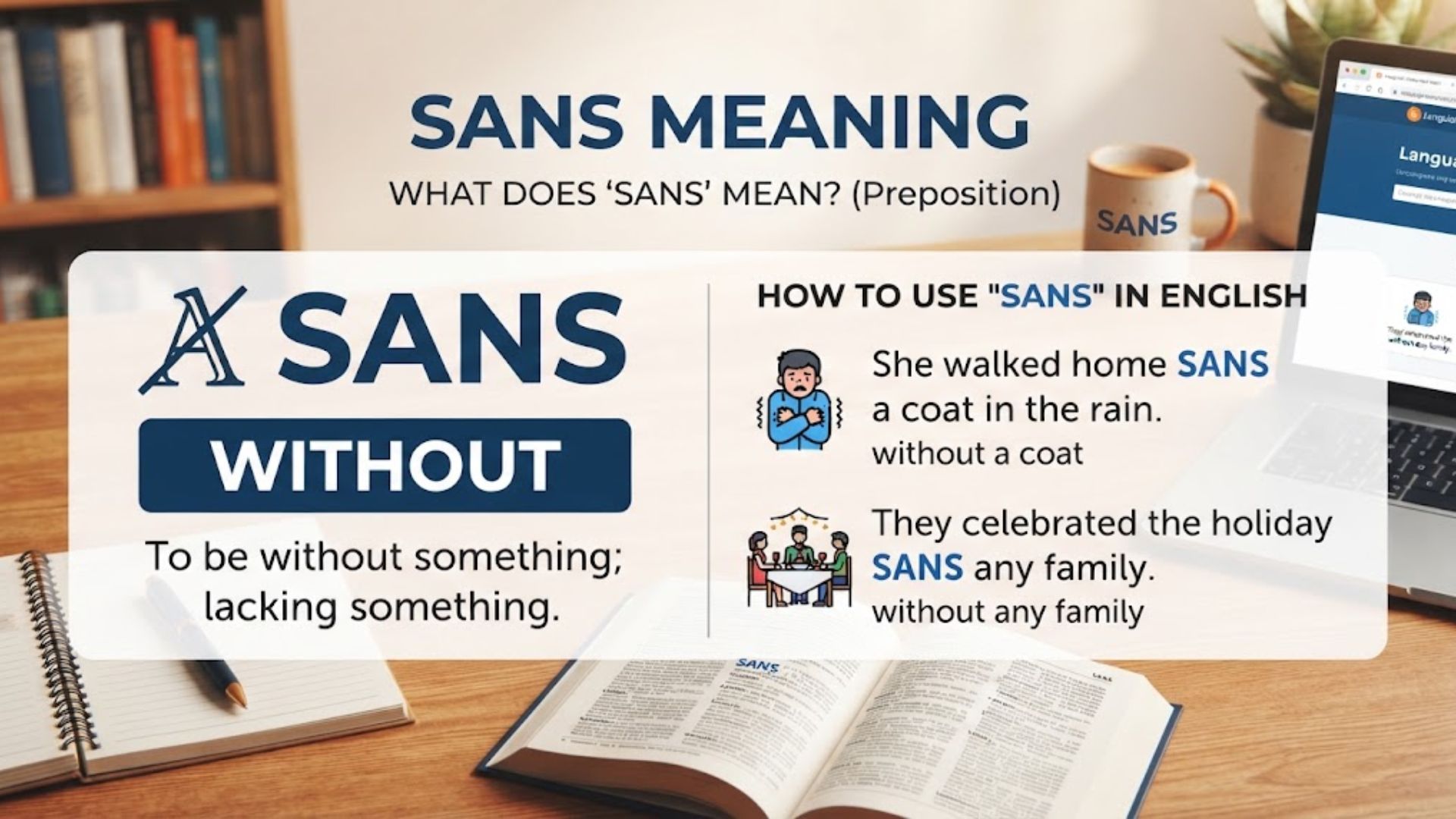

You may have seen “sans” on a menu, in a caption, or in a news headline. It looks fancy, but the idea is simple. This guide explains the sans meaning in plain English. You will learn how to say it, how to use it, and when to skip it. You will also find easy examples, tables, and common mistakes.
Quick Answer
Sans means “without.” It is a preposition borrowed from French. You place it before a noun. For example: “coffee sans sugar” means coffee without sugar.
TL;DR
- Sans = without, lacking, or in the absence of.
- It is pronounced “sanz” in English.
- It sounds playful, stylish, or literary.
- Use “without” in most daily talk.
- Do not use “sans” before verbs ending in -ing.
- “Sans” also appears in sans-serif, Comic Sans, and Médecins Sans Frontières.
What “Sans” Means in English
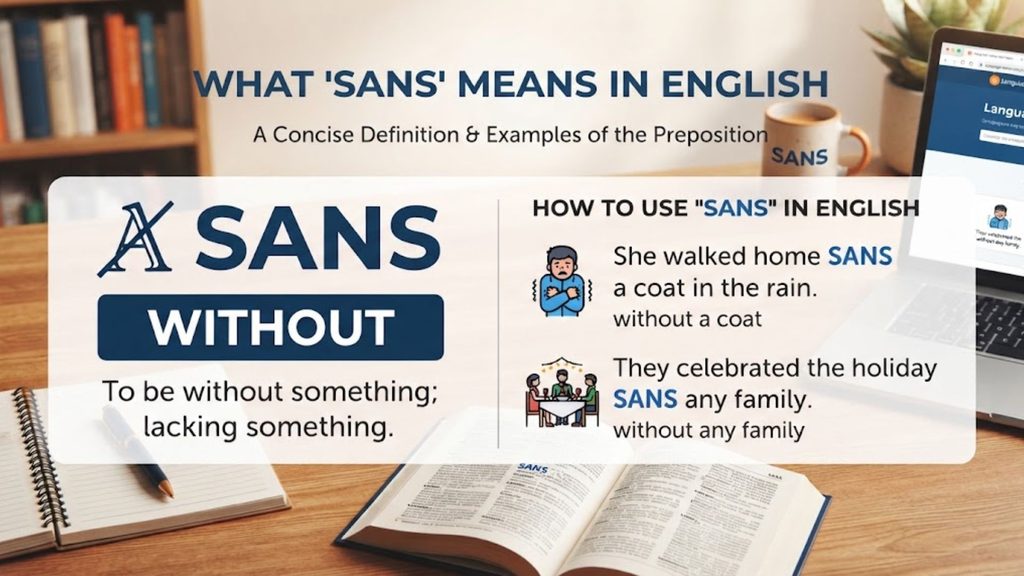
“Sans” shows that something is missing. It is a small word, but it carries a clear idea. The thing after “sans” is not there.
The word comes from Old French. Its roots go back to the Latin word sine, which also means “without.” English speakers have used it for about 700 years. Still, it never fully became an everyday English word. It keeps a slightly French and fancy feel.
Dictionaries often describe it as a more playful or literary way to say “without.” People use it when they want to sound witty or polished.
Examples:
- “I’ll take my tea sans milk.”
- “He walked into the meeting sans notes.”
- “A weekend sans phones sounds perfect.”
Part of Speech and Grammar Role
“Sans” is a preposition. A preposition links a noun to the rest of the sentence. “Sans” works just like “without” or “minus.”
Simple formula:
sans + noun or noun phrase
Here are a few clear examples:
- ✅ “A pizza sans cheese.”
- ✅ “A world sans war.”
- ✅ “She arrived sans her usual smile.”
- ❌ “She left sans saying goodbye.”
The last sentence sounds wrong. “Sans” is rarely used before a verb with -ing. In that case, use “without saying goodbye.”
Pronunciation of “Sans”
In English, most people say “sanz” (IPA: /sænz/). The “s” at the end sounds like a “z.” It rhymes with “fans” and “plans.”
Some speakers use the French style. It sounds like “sahn” (/sɑ̃/) with a soft nasal sound. You may hear this in French phrases like “sans souci.”
Both ways are fine. For daily English, the “sanz” version is the safest choice.
Where the Word Comes From
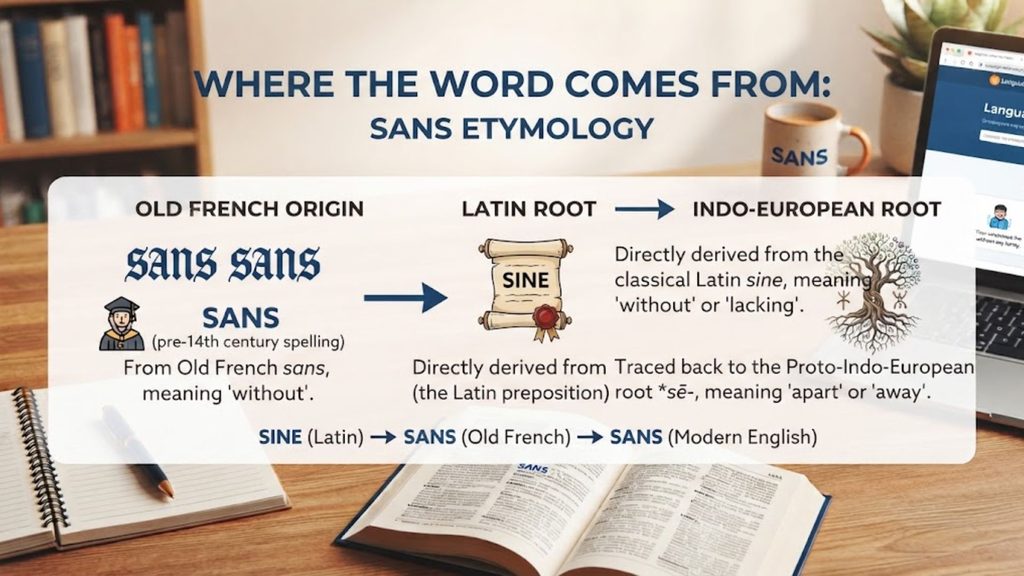
The word has a long history. It started in Latin as sine, meaning “without.” Over time, Old French shaped it into forms like sens and sans. By the 1300s, English writers had begun to use it.
This old link explains why “sans” appears in many French-based phrases. English kept those phrases as they were. That is why you see “sans” in names, fonts, and sayings today.
Sans Meaning in Different Contexts
People search for “sans” in many different ways. Here is a clear guide to each one.
Sans Meaning in Law
In legal writing, “sans” shows up in French-based phrases. A well-known one is “sans recours,” which means “without recourse.” It can be written on financial papers such as checks or notes. It tells the holder that they cannot go back to the signer for payment if something goes wrong.
You may also see “sans” in older legal texts. It is rare in modern plain-language law.
Sans Meaning “Without”
This is the main meaning. Almost every dictionary lists “without” first. Some also add “in the absence of” or “lacking.”
Comic Sans Meaning
Comic Sans is a popular casual font. Here, “sans” is short for sans-serif. A serif is a small decorative stroke at the end of a letter. A sans-serif font has none. So “Comic Sans” means a comic-style font without serifs.
No Sans Meaning
“No sans” is not a proper English phrase. “Sans” already means “without,” so adding “no” creates a double negative. If you see it online, it is usually a typo or a joke.
Avec Sans Meaning
In French, avec means “with” and sans means “without.” They are opposites. “Avec sans” together is not a real phrase. People often compare them like this: “avec sucre” (with sugar) and “sans sucre” (without sugar).
Word Sans Meaning
As a plain word, “sans” means “without.” In some dictionaries, “Sans.” is also a short form of Sanskrit. Online, “Sans” can also be the name of a popular video game character, so the meaning depends on the context.
Free of Sans Meaning
“Free of sans” is not a normal phrase. “Free of” and “sans” both show absence. Using them together is repetitive. Say “free of sugar” or “sans sugar,” but not both.
Amour Sans Meaning
In French, amour means “love.” “Amour sans” is the start of phrases like “amour sans fin” (love without end) or “amour sans limite” (love without limits). You will often see these on cards, jewelry, and romantic quotes.
Famous Phrases That Use “Sans”
You already know “sans” from many well-known names and terms. Here are some of them.
| Phrase | Meaning | Where You See It |
| Sans-serif | A font without small end strokes | Fonts like Arial and Helvetica |
| Comic Sans | A casual sans-serif font | Posters, flyers, memes |
| Sans souci | Without worry | Palaces, hotels, songs |
| Médecins Sans Frontières | Doctors Without Borders | Medical aid group |
| Sans-culottes | Revolutionaries “without fine breeches” | French Revolution history |
| Sans recours | Without recourse | Legal and financial papers |
These examples show how deeply “sans” has entered English.
Everyday Usage of “Sans”
“Sans” appears in many daily places. Here are the most common ones:
- Food and drinks: “Latte sans sugar.”
- News and media: “The team played sans their star player.”
- Social media captions: “Weekend sans worries.”
- Design and fonts: “Use a clean sans-serif font.”
- Humor and jokes: “Monday sans coffee is a crime.”
It shows up more in writing than in speech. When it is spoken, it often gives a playful tone.
RANDOM MEANINGS GENERATOR
What Does It Mean?
Search words, slang, abbreviations and texting terms to find their meaning.
✨ Popular Meanings
🔤 Browse Meanings A–Z
Find Texting, Slang & Abbreviation Meanings
Use this meaning finder to quickly search common texting abbreviations, internet slang, acronyms and chat expressions. Enter a term such as LOL, IDK, FR, FLM or FCA to see its meaning, definition, example, usage and tone. You can also browse popular terms or explore meanings alphabetically.
Formal vs Informal Tone
“Sans” can feel different depending on where you use it. This table makes it easy to see.
| Tone | How “Sans” Feels | Example |
| Formal writing | Literary, polished | “A report sans errors.” |
| Informal writing | Playful, witty | “Pizza sans pineapple, please.” |
| Casual speech | A bit unnatural | Better to say “without” |
| Business emails | Too fancy | Use “without” |
| Captions and posts | Stylish and fun | “Sunday sans stress.” |
So “sans” fits best in creative writing, humor, and stylish captions.
“Sans” vs “Without”
Both words mean the same thing. The real difference is tone and use.
| Feature | Sans | Without |
| Meaning | Absence of something | Absence of something |
| Tone | Fancy, playful, literary | Neutral, everyday |
| Used before -ing verbs | Rarely | Yes |
| Common in speech | No | Yes |
| Common in writing | Sometimes | Always |
| Best for | Captions, creative writing | All situations |
Quick tip: If you are unsure, pick “without.” It is always safe and correct.
Other Words Close to “Sans”
“Sans” has a few simple cousins. Each one has a small difference.
- Without: The standard word. Works everywhere.
- Lacking: Often shows a need or weakness. “A plan lacking detail.”
- Minus: Informal and short. “Burger minus the cheese.”
- Absent: Used when something is not present. “A room absent of noise.”
- Devoid of: Strong and formal. “A speech devoid of emotion.”
Common Examples in Sentences
Seeing real sentences makes a new word easier to learn. Here are some simple ones.
Food and drink
- “She ordered a burger sans onions.”
- “I’ll have my coffee sans cream.”
- “They baked a cake sans sugar.”
Daily life
- “He arrived at the party sans invitation.”
- “A summer sans rain feels strange.”
- “Life sans music would be dull.”
Work and tech
- “They launched the app sans any ads.”
- “The movie was released sans trailer.”
- “The team finished the project sans extra help.”
Creative and fun
- “A world sans hate is a beautiful dream.”
- “Monday sans coffee? No, thank you.”
- “Weekend sans alarm clocks. Pure joy.”
When to Use “Sans”
Use “sans” when you want a light, stylish, or witty effect. It works well in these cases:
- Creative writing: Stories, poems, and blog posts.
- Social media captions: Short and trendy lines.
- Food talk: Menus and recipes with a playful voice.
- Humor: Jokes and clever remarks.
- Design terms: Words like sans-serif.
- Quotes and titles: A poetic touch, like “Life sans Fear.”
A good rule is simple. Use “sans” when the tone is light. Use it when you want to sound a little clever.
When Not to Use “Sans”
Skip “sans” in these cases:
- Serious emails and business reports: It may sound odd.
- Simple everyday speech: “Without” is more natural.
- Before -ing verbs: It sounds wrong.
- With double negatives: Avoid “no sans” or “not sans.”
- For young or new learners: They may not know the word.
- In legal or safety notices: Clear words matter more than style.
If your reader might get confused, choose the simpler word.
Common Mistakes
Learners often make the same few errors. Here is how to fix them.
| Mistake | Why It’s Wrong | Correct Version |
| “She left sans saying goodbye.” | “Sans” is rarely used before -ing verbs | “She left without saying goodbye.” |
| “I forgot my keys, so I’m locked out sans my bag.” | Too fancy for a casual moment | “…without my bag.” |
| “No sans sugar.” | Double negative | “Sans sugar.” |
| “Free of sans.” | Repeats the same idea | “Sans sugar.” |
| “Sans” pronounced like “sands” | Wrong sound | Say “sanz” |
| “Sans of” | “Sans” does not need “of” | “Sans sugar.” |
Tips to avoid mistakes:
- Always place a noun right after “sans.”
- Keep the tone light or creative.
- Do not mix “sans” with other negative words.
- When in doubt, use “without.”
FAQs
What does “sans” mean?
“Sans” means “without.” It comes from French and shows that something is missing.
What does “sans” mean in English?
In English, “sans” is a preposition meaning “without” or “lacking.” It sounds a bit fancy or playful.
What does “sans” mean in slang?
In slang, “sans” is a stylish way to say “without,” as in “party sans drama.” Online, it can also point to a well-known game character.
How to use sans correctly?
Put “sans” before a noun, like “tea sans sugar.” Do not use it before verbs ending in -ing.
Is “sans” a French or English word?
It started as French but has been used in English for centuries. Today, it is listed in English dictionaries.
What is the difference between “sans” and “sans-serif”?
“Sans” means “without.” “Sans-serif” is a font style with no small strokes at the letter ends, like Arial.
Can I use “sans” in formal writing?
Yes, but sparingly. It suits literary or stylish writing. For business emails, “without” is safer.
How do you pronounce “sans”?
Most people say “sanz.” Some use the French sound, “sahn.”
Conclusion
The sans meaning is easy to remember: it means “without.” It is a short, stylish word that adds flair to your writing. You can use it for food, captions, fonts, and clever remarks. You can also spot it in famous phrases like sans-serif, sans souci, and Médecins Sans Frontières.
Still, keep it simple in daily talk. Choose “without” for formal or casual speech, and save “sans” for moments when you want a little wit. Place it before a noun, avoid -ing verbs, and skip double negatives. Now you know how to say it, use it, and avoid the common mistakes.

1 thought on “Sans Meaning: What Does “Sans” Mean and How to Use It in English?”