
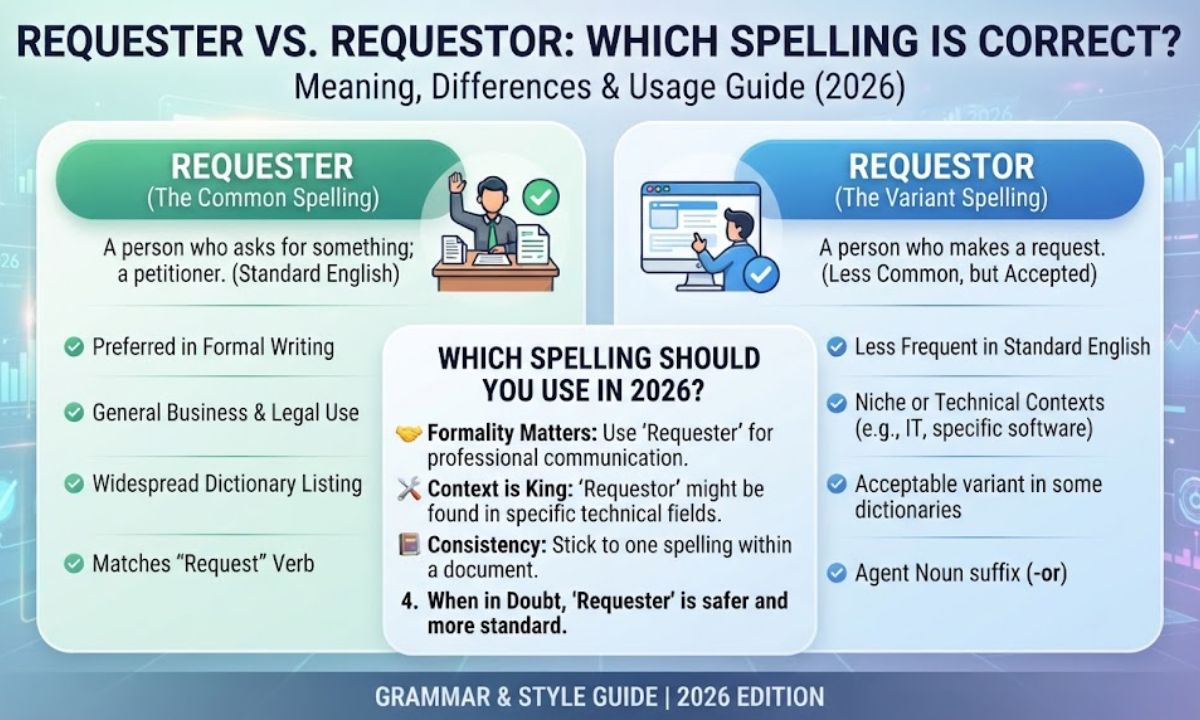

If you’ve ever paused mid-sentence wondering whether to type “requester” or “requestor,” you’re not alone. This is one of the most common spelling mix-ups in business writing, and honestly, both versions are correct. The real question isn’t which one is right — it’s which one fits your context.
This guide breaks down the meaning, origin, and real-world usage of both spellings so you never have to second-guess yourself again.
Stop Guessing: Requester vs Requestor Explained Clearly
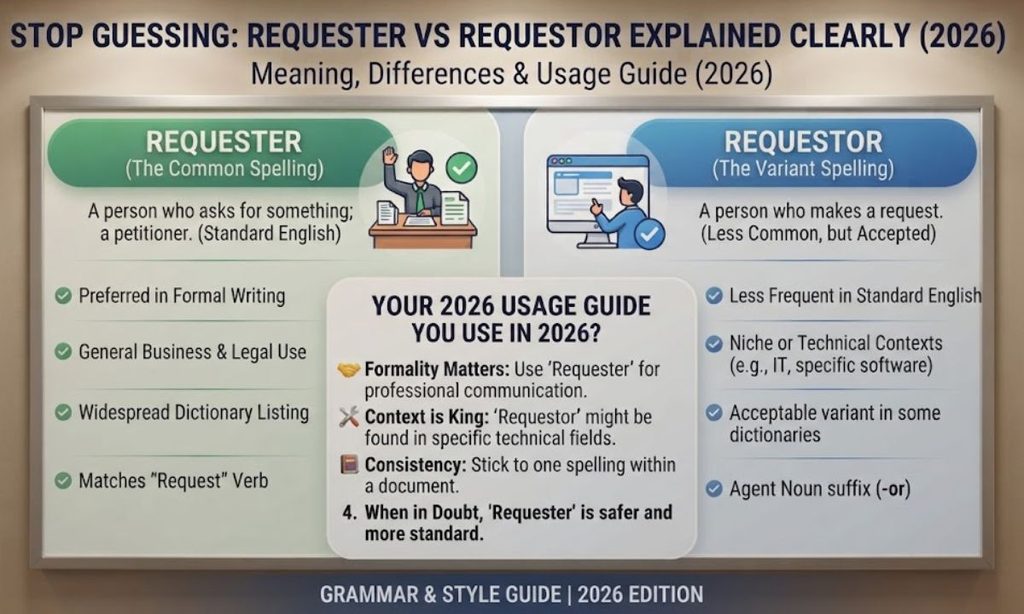
Here’s the short answer: requester and requestor mean exactly the same thing — a person or entity that makes a request. Neither spelling is a typo. The difference comes down to formality, industry convention, and regional habit, not correctness.
- Requester is the more common, everyday spelling used in general writing, business emails, and casual communication.
- Requestor shows up more often in legal, technical, and procurement documents, where it carries a slightly more formal tone.
Once you understand where each one fits, you’ll never have to guess again.
Requester Meaning and Requestor Meaning
Requester Meaning
A requester is someone who asks for something — information, permission, an item, or an action. It’s the standard agent noun formed from the verb “request” plus the suffix “-er,” similar to words like “worker” or “helper.”
Requestor Meaning
A requestor carries the exact same definition: a person making a request. The spelling simply swaps the “-er” ending for “-or,” giving it a more formal or legalistic feel, similar to “contractor” or “executor.”
Why Do Two Spellings Exist?
English forms agent nouns (words describing “the person who does something”) in two main ways — with “-er” or “-or.” The “-er” ending has Germanic roots and feels more conversational, while the “-or” ending traces back to Latin and often appears in formal or legal vocabulary. Over time, both spellings survived because different industries adopted different conventions.
A few quick facts worth knowing:
- Requester synonym: asker, applicant, petitioner, or claimant, depending on context.
- Requestor or requester Oxford dictionary: major dictionaries, including Oxford, list “requester” as the primary spelling, with “requestor” noted as a valid variant.
- Requester or requestor UK: British English leans slightly more toward “requester,” though both appear in UK business and legal writing.
- Requester vs requestor examples: “The requester submitted a leave form” and “The requestor must sign the compliance agreement” are both grammatically correct.
Agent Noun Pattern Table
| Suffix | Origin | Feel | Examples |
| -er | Germanic | Casual, everyday | worker, helper, requester |
| -or | Latin | Formal, technical/legal | contractor, executor, requestor |
Requester vs Requestor Usage in Modern Writing
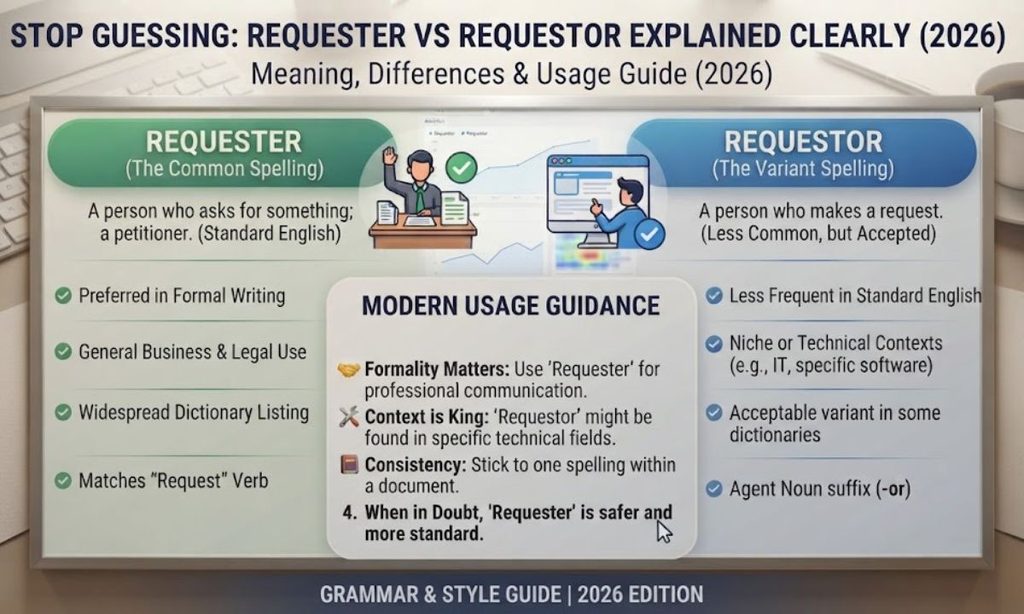
In General Writing
Blog posts, emails, articles, and everyday communication almost always use requester. It reads naturally and doesn’t distract readers.
In Legal Documents
Legal writing often uses requestor, especially when the word functions as a defined term inside a contract or statute.
In Procurement Systems
Many procurement and purchasing platforms use requestor as a formal job-role label, referring to the employee who initiates a purchase request.
Also read this OZDEKENOSIS MEANING
In Technical and API Documentation
Software documentation and API references frequently use requester to describe the client or user making a call, though “requestor” also appears in older technical specs.
When to Use Requester
Use “requester” when writing for a general audience, drafting emails, creating web content, or following most modern style guides. It’s the safer, more widely recognized default.
Why Requester Feels More Natural
It follows the most common English agent-noun pattern (verb + “-er”), so readers process it faster and it feels less stiff.
When to Use Requestor
Use “requestor” when you’re working inside a legal, procurement, or technical document that already uses this spelling as an established or defined term. In these cases, consistency matters more than personal preference.
Requester vs Requestor Examples
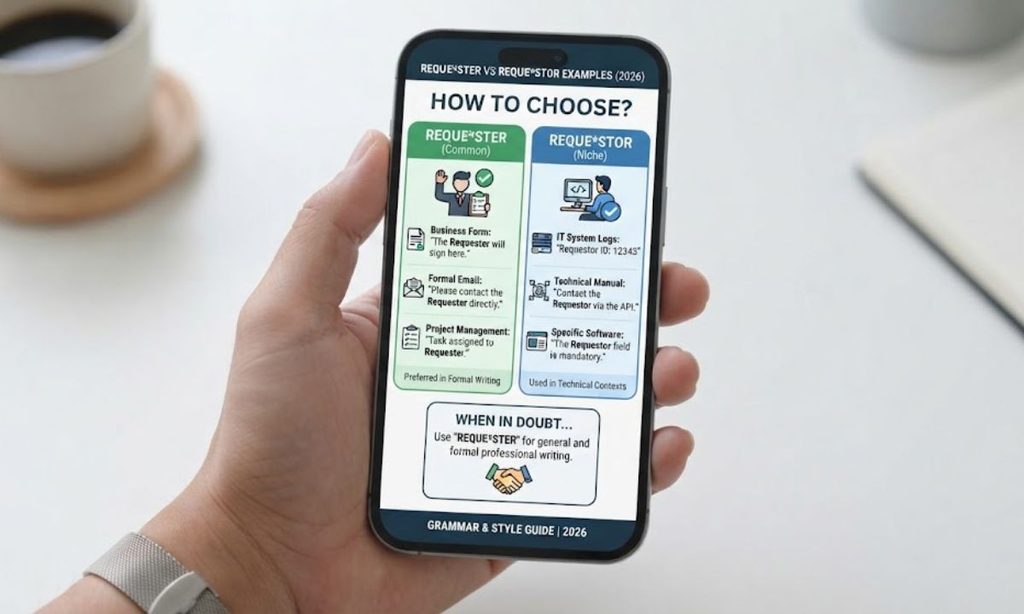
Everyday Business Email
“Hi team, the requester has asked for an update on their ticket status.”
Procurement Workflow
“The requestor must submit an approved purchase order before the vendor can proceed.”
Legal Agreement
“Requestor shall provide written notice within 30 days of the request date.”
IT Service Ticket
“Requester: John Smith. Issue: Password reset needed.”
Difference Between Requester and Requestor
| Feature | Requester | Requestor |
| Meaning | Person who makes a request | Person who makes a request |
| Common use | General writing, emails, tech docs | Legal, procurement, formal contracts |
| Tone | Casual, everyday | Formal, official |
| Dictionary preference | Primary spelling | Accepted variant |
| Suffix origin | Germanic (-er) | Latin (-or) |
Requester vs Requestor UK Usage
In UK English, “requester” is generally the more dominant spelling in day-to-day writing, mirroring US usage. However, “requestor” still appears in British legal and government documents, so it isn’t considered incorrect — just less frequent outside formal settings.
Requester vs Requestor in Legal and Technical Contexts
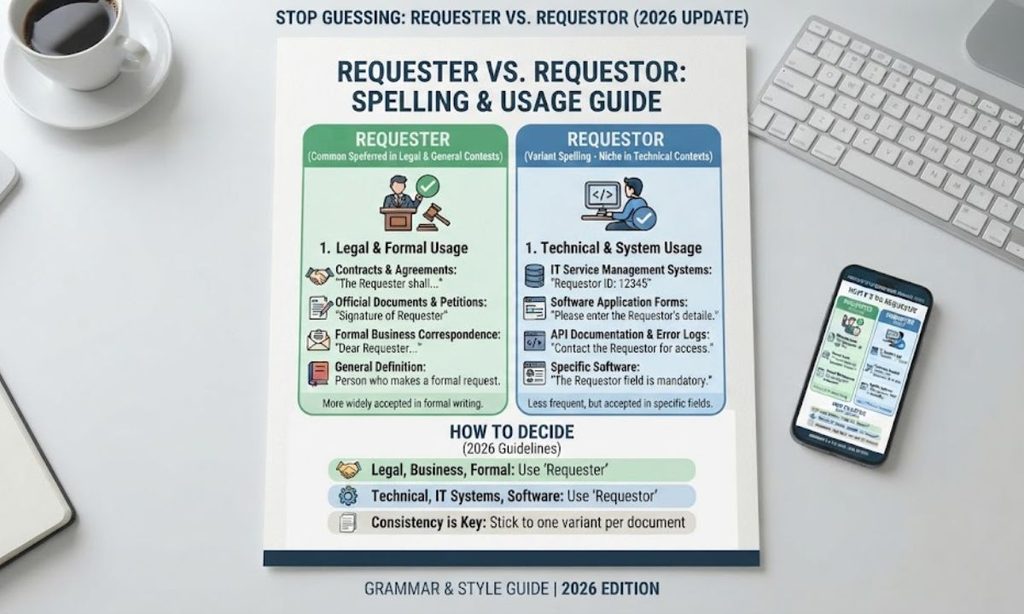
Legal Writing Pattern
Legal documents often capitalize the term when it’s used as a defined party, such as “Requestor” or “Requester,” and this defined spelling should be used consistently throughout the entire document.
Common Mistakes and Fixes
Mixing Spellings
Switching between “requester” and “requestor” within the same document looks inconsistent and unprofessional. Pick one and stick with it.
Correcting a Defined Term
If a contract has already defined “Requestor” as a legal term, don’t “fix” it to “requester” — that changes the document’s internal consistency.
Assuming One Is Wrong
Neither spelling is a grammar mistake. Treating one as flat-out incorrect is itself the error.
Quick Reference Table
| Situation | Recommended Spelling |
| Blog or website content | Requester |
| Business email | Requester |
| Legal contract | Requestor (if already defined) |
| Procurement software | Requestor |
| API/technical documentation | Requester |
| Academic writing | Requester |
Requester vs Requestee vs Requestor
- Requester/Requestor – the person making the request.
- Requestee – the person or entity receiving the request (less common, but used in some legal and technical writing).
Related Terms and Synonyms
Common alternatives include applicant, petitioner, claimant, asker, and initiator, depending on the formality and context of your writing.
Grammar Details: Plural, Opposite, and Name Fields
Requester Plural
The plural form is simply requesters (add “s”).
Requester Opposite
The closest opposite is requestee or recipient — the person the request is directed toward.
Requester Name Field
In forms and software systems, “Requester Name” is the standard label used to capture who submitted a request.
Requestor Pronunciation
“Requestor” is pronounced the same as “requester” — /rɪˈkwɛstər/ — the spelling difference doesn’t change how it sounds.
Business Writing Tips for Choosing the Right Spelling
Match the Audience
Formal, legal, or procurement audiences may expect “requestor,” while general audiences respond better to “requester.”
Follow the Style Guide
If your company or publication has a style guide, follow its preferred spelling to stay consistent across all content.
Prioritize Writing Clarity
Choose the spelling that won’t distract your reader — clarity always outranks personal preference.
Keep It Simple
When in doubt, default to “requester.” It’s the more universally recognized and widely accepted spelling.
Here are some additional high-search points added into the relevant sections — checked against what’s already there so nothing repeats.
Requester Meaning and Requestor Meaning (additional points)
- Requester vs requestor Merriam-Webster: Merriam-Webster primarily lists “requester,” though “requestor” is widely recognized as an acceptable variant in professional use.
- Requester vs requestor grammarly: Grammarly generally flags “requester” as the standard spelling and may underline “requestor” as a less common variant, though it isn’t marked as incorrect.
- Is requestor a Scrabble word: Yes, both “requester” and “requestor” are valid in most Scrabble dictionaries.
When to Use Requester (additional point)
- Requester meaning in English: Simply put, if you’re asking “what does requester mean in English,” it refers to anyone — a person, department, or system — that initiates a request for something.
When to Use Requestor (additional point)
- Requestor meaning in law: In legal contexts, “requestor” often refers specifically to the party formally petitioning for records, documents, or official action, such as in Freedom of Information Act (FOIA) requests.
Requester vs Requestor Examples (additional example)
FOIA / Government Request
“The requestor filed a Freedom of Information Act request with the agency.”
New Section: Requester vs Requestor in FOIA and Government Use
Government and public records requests are one of the biggest real-world sources of this spelling debate. Many U.S. state and federal FOIA statutes officially use “requestor” as the defined legal term for the person seeking records, which is why this spelling shows up so often in government forms and public records websites.
New Section: Salesforce, ServiceNow, and Software Usage
Software platforms don’t always agree on spelling either:
| Platform Type | Common Spelling Used |
| Salesforce | Requester |
| ServiceNow (ITSM) | Requested By / Requestor (varies by module) |
| Jira Service Management | Requester |
| Government/legal portals | Requestor |
If your company uses one of these systems, match the spelling the software already displays in its fields and reports to avoid confusion in tickets and workflows.
Common Mistakes and Fixes
Autocorrect Overriding Your Choice
Some word processors and browsers auto-correct “requestor” to “requester.” If your document intentionally uses “requestor” as a defined legal term, double-check that autocorrect hasn’t silently changed it.
Frequently Asked Questions
Is “requestor” a real word?
Yes, “requestor” is a legitimate English word and an accepted variant spelling of “requester.”
Which spelling do dictionaries prefer?
Most major dictionaries, including Oxford, list “requester” as the primary spelling, with “requestor” noted as a valid alternative.
Can I use both spellings in the same document?
No, mixing spellings within one document looks inconsistent — pick one and use it throughout.
Is “requestor” more formal than “requester”?
Yes, “requestor” tends to carry a more formal, legal, or technical tone compared to “requester.”
What is the plural of requester?
The plural is simply “requesters.”
What is the opposite of a requester?
The opposite is a “requestee,” the person or party receiving the request.
Is “requester” or “requestor” used in APIs?
“Requester” is more common in modern API documentation, though older or enterprise systems sometimes use “requestor.”
Does Microsoft Word prefer requester or requestor?
Microsoft Word’s spell-checker generally accepts both, but its autocorrect and grammar suggestions tend to favor “requester.”
Which spelling is used in FOIA requests?
Many FOIA statutes and government forms officially use “requestor” as the defined legal term.
Final Thoughts: Requester or Requestor?
Both spellings are correct, and neither one is a mistake. For everyday writing, emails, and general content, requester is the safer and more natural choice. For legal, procurement, or technical documents that already use requestor as an established term, stick with that spelling for consistency. When in doubt, match your audience, follow your style guide, and keep your usage consistent throughout the document.

1 thought on “Requester vs. Requestor: Which Spelling Is Correct? Meaning, Differences & Usage (2026)”