

Have you ever stopped mid-sentence and wondered, “Is it coming or coming?” You are not alone. This is one of the most common spelling doubts in English, and it shows up in emails, texts, school essays, and social media posts.
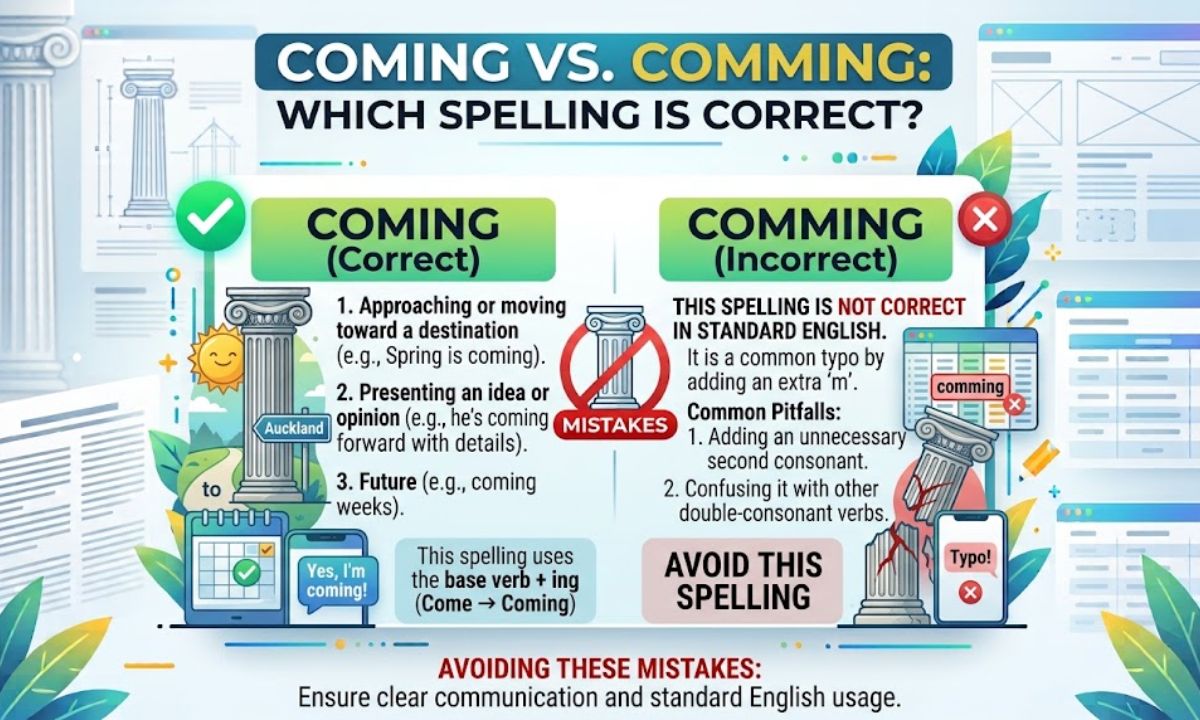
The answer is simple. “Coming” is the correct spelling. “Comming” is a spelling mistake. In this guide, you will learn why, how to remember it, and how to use “coming” correctly in many kinds of sentences. You will also see related word pairs that often confuse learners, such as upcoming vs. incoming vs. oncoming.
Coming vs. Comming: The Quick Answer
Coming is the correct spelling. It is the “-ing” form of the verb come. Coming is not a word in English dictionaries.
| Spelling | Correct? | Why |
| Coming | ✅ Yes | Drop the silent “e” from “come,” then add “-ing” |
| Comming | ❌ No | The “m” is doubled for no reason, and no spelling rule supports it |
Remember: come → coming, not come → coming.
What Does Coming Mean?
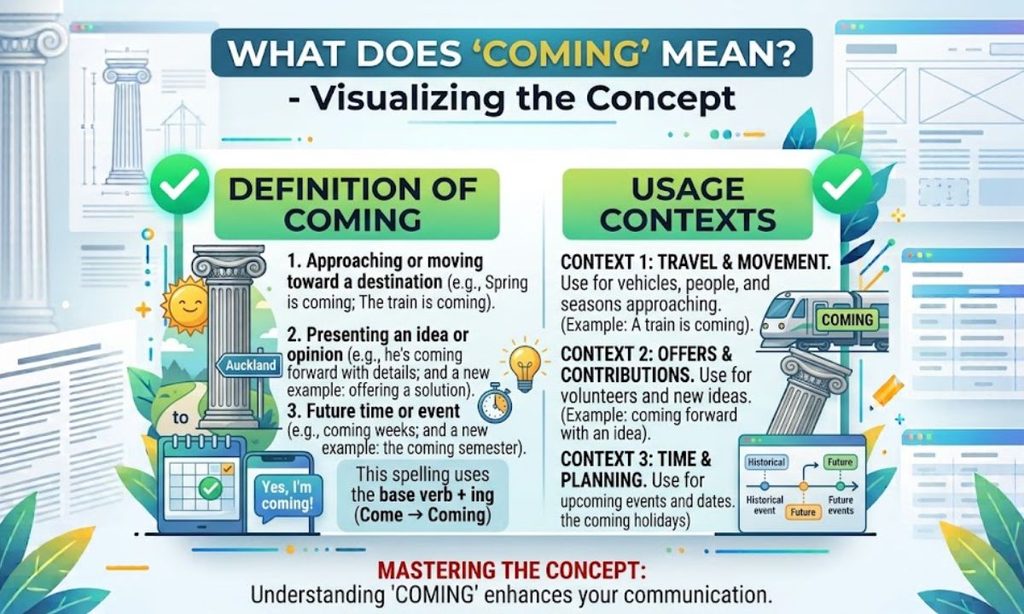
“Coming” is a word built from the verb “come.” Its meaning depends on how it is used in a sentence. Here are the main meanings:
- Moving toward a place or person. Example: “My cousin is coming to the party.”
- Arriving or about to arrive. Example: “The bus is coming now.”
- Happening in the near future. Example: “The coming week looks busy.”
- Reaching a state or condition. Example: “He is coming to understand the problem.”
In short, “coming” describes movement toward something, or something that is about to happen. It can work as a verb form, a noun-like word, or an adjective. You will see all three uses later in this article.
Why Is Coming Correct?
“Coming” follows a very common English spelling rule. The rule has two steps:
- Start with the base verb: come.
- If a verb ends in a silent “e,” drop the “e” before adding “-ing.”
So we get to come → coming.
Many other verbs follow the same rule:
| Base Verb | + -ing |
| make | making |
| take | taking |
| write | writing |
| give | giving |
| have | having |
| use | using |
| move | moving |
| love | loving |
Notice that none of these doubles its last letter. “Come” is no different. It already ends in “e,” so the “e” falls away. Nothing else changes.
Why Is Coming Incorrect?
“Comming” breaks the spelling rule. Here is why it is wrong:
- It is not in standard dictionaries. No trusted English dictionary lists it.
- It doubles the “m” without a reason. Doubling only happens in certain cases, and “come” is not one of them.
- It does not match the sound. The word “coming” is pronounced /ˈkʌm.ɪŋ/. The “m” sound is short and single.
- It looks like a different word pattern. Words such as “common,” “comma,” and “committee” have double “m.” This can fool the eye.
So “comming” is simply a spelling error. Spell checkers will underline it in red every time.
Coming vs. Coming Examples
Seeing the right and wrong forms side by side helps you remember the difference.
| ✅ Correct | ❌ Incorrect |
| She is coming home tonight. | She is coming home tonight. |
| Summer is coming soon. | Summer is coming soon. |
| Are you coming with us? | Are you coming with us? |
| The coming year will be better. | The coming year will be better. |
| He kept coming back for more. | He kept coming back for more. |
Coming or Coming: Which Spelling Is Correct?
Again, the answer is clear. Coming is correct. Use it in every kind of writing, such as school work, business emails, news articles, and casual chats. There is no situation in standard English where “coming” is acceptable.
Examples with Coming
Here are simple, correct sentences with “coming”:
- My parents are coming to visit next week.
- Is the train coming on time?
- Good things are coming your way.
- She was coming down the stairs when the phone rang.
- The coming election is a hot topic.
- I am coming, please wait for me.
- Winter is coming, so pack warm clothes.
- They were coming from the market when it started to rain.
- His new book is coming out in May.
- The best is yet to be coming.
Incorrect Examples with Coming
These sentences contain the common mistake. Do not copy them:
- ❌ My parents are comming to visit next week.
- ❌ Is the train comming on time?
- ❌ Good things are comming your way.
- ❌ The comming election is a hot topic.
- ❌ I am comming, please wait for me.
The fix is the same each time. Remove the extra “m” and write.
Coming in Different Grammatical Uses
“Coming” can play different roles in a sentence. It can act as a present participle, a gerund, or an adjective. Each role is explained below.
Coming vs. Comming: Correct Spelling Explained Clearly
Let us break the spelling down step by step.
- Step 1: Take the verb “come.”
- Step 2: Look at the last letter. It is a silent “e.”
- Step 3: Remove that “e.” You now have “com.”
- Step 4: Add “-ing.” You get “coming.”
You never add a second “m.” There is no step for it.
A useful point to keep in mind: English doubles the last consonant mostly when a short word ends in consonant + vowel + consonant. Examples are run → running and sit → sitting. “Come” ends in a vowel (“e”), so this doubling rule does not apply.
Coming or Coming ~ How to Spell It Correctly
Here is a short checklist you can use every time:
- ✅ Write one “m” in the middle.
- ✅ Make sure there is no “e” before “-ing.”
- ✅ Read the word out loud: “KUM-ing.”
- ✅ If your spell checker flags “comming,” fix it right away.
If you can say “come” and then “coming,” you can spell the word correctly. Think of the word as COM + ING. Nothing more.
RANDOM MEANINGS GENERATOR
🔎 Find Any Word Meaning
Type an English word to see its meaning, examples and synonyms.
Coming as a Present Participle
A present participle is the “-ing” form of a verb. It is often used with “is,” “are,” “was,” or “were” to show an action in progress.
Examples:
- She is coming to the meeting.
- They are coming by car.
- I was coming home when I saw him.
- We were coming to tell you the news.
In these sentences, “coming” shows that the action is happening now, or was happening at a certain time.
Coming as a Gerund
A gerund is an “-ing” word that works like a noun. It can be the subject or object of a sentence.
Examples:
- Coming early helps you avoid the crowd. (subject)
- I enjoy coming to this café. (object)
- She is worried about coming late. (after a preposition)
Here “coming” names an action. It does not describe an action in progress.
Coming as an Adjective
“Coming” can also describe a noun. In this role, it often means “approaching” or “next.”
Examples:
- The coming weekend is a long one.
- We are ready for the coming challenges.
- The coming generation will use new tools.
When used this way, “coming” usually sits before the noun it describes.
Common Phrases With Coming
“Coming” appears in many everyday phrases. Learning them will help your speaking and writing sound natural.
Coming Soon
“Coming soon” means something will be available or will happen shortly. You see it on movie posters, shop windows, and websites.
- “The new menu is coming soon.”
- “Our app is coming soon to Android.”
A quick note: The phrase is the same everywhere: coming soon. Some people mix it up with “coming up soon,” which also means “about to happen.” Both are fine, but “coming soon” is the standard phrase for announcements.
Coming Up
“Coming up” means about to happen, or about to be shown or discussed.
- “Coming up next, the weather report.”
- “I have a big exam coming up.”
Coming Back
“Coming back” means returning to a place, person, or condition.
- “I am coming back tomorrow.”
- “Her old habits keep coming back.”
Coming Home
“Coming home” means returning to your house, or to a place you belong.
- “The soldiers are coming home this week.”
- “I love coming home after a long trip.”
Coming Along
“Coming along” means making progress, or joining someone.
- “The project is coming along nicely.”
- “Are you coming along with us?”
Coming vs. Coming in American English
Some spelling words change between American and British English, such as color and colour. But this is not one of them. Both American and British English spell the word coming. “Comming” is wrong in the US, the UK, Canada, Australia, and everywhere else English is used.
So you do not need to worry about regional differences here. The spelling is the same for all.
Why Do People Spell Coming as Coming?
If the rule is so clear, why does the mistake happen? There are a few reasons:
- Confusion with doubling rules. Learners know that words like running and sitting double the last letter. They apply the same idea to “coming.”
- Look-alike words. Words such as common, comma, commit, and committee have a double “m.” The eye gets used to seeing “mm.”
- Fast typing. When you type quickly, an extra letter can slip in.
- Sound confusion. The “m” sound in “coming” feels strong, so people think it needs two letters.
- Mixing with “comin’.” In casual speech and song lyrics, the “g” is dropped. This can blur how people picture the word.
Knowing why the mistake happens makes it easier to avoid.
A Simple Trick to Remember Coming
Try one of these easy memory tricks:
- Think “come” + “ing.” If you can spell “come, you only drop the “e” and add “ing.”
- One “m” is enough. Say to yourself: “Only one ‘m’ is coming.”
- Compare with similar verbs. You write making, taking, and giving. Not makking, takking, or givving. So you write coming.
- Use a rhyme. “Drop the ‘e,’ add ‘ing,’ keep one ‘m.'”
Repeat the trick a few times. Soon the correct spelling will feel natural.
Coming vs. Comming: Common Mistakes
Let us look at the three most frequent errors.
Mistake 1: Doubling the M
This is the biggest mistake. Writers type “comming” because they think the “m” must be doubled.
- ❌ She is comming tomorrow.
- ✅ She is coming tomorrow.
Mistake 2: Keeping the Final E
Some people forget to drop the silent “e.” They write “comeing.”
- ❌ The bus is comeing.
- ✅ The bus is coming.
“Comeing” is also wrong. Remember that the final “e” is dropped before “-ing.”
Mistake 3: Using Comming in Professional Writing
In emails, reports, resumes, and websites, a spelling error looks careless. Writing “comming” in a business message can hurt your image.
- ❌ Our new product is comming next month.
- ✅ Our new product is coming next month.
Always proofread important messages before sending them.
Coming in Questions
You can use “coming” to ask about movement or arrival. Most questions use “are,” “is,” or “was” before “coming.”
- Are you coming to the party?
- Is the delivery coming today?
- When are they coming home?
- Who is coming for dinner?
- Why are you coming so late?
Coming in Negative Sentences
To make a negative sentence, add “not” after the helping verb.
- I am not coming to the meeting.
- She is not coming today.
- They are not coming back.
- The train isn’t coming on time.
- We aren’t coming this weekend.
Coming in Future-Related Expressions
“Coming” is very useful for talking about the future. It points to things that are close in time.
- The coming days will be cold.
- Coming soon to theatres near you.
- There are coming changes to the rules.
- The coming year holds many chances.
- A big announcement is coming next week.
In these examples, “coming” tells us the event is near, not far away.
Related Words That Often Confuse Learners
Many readers who search for “coming vs coming” also look up similar word pairs. Here are the most common ones, explained simply.
Coming vs. Come
- Come is the base verb. Example: “Please come here.”
- Coming is the “-ing” form. Example: “I am coming now.”
Use “come” for commands and simple presents. Use “coming” for actions in progress or for the near future.
Coming vs. Going
These two are opposite directions.
- Coming = moving toward the speaker or a place.
- Going = moving away from the speaker or toward another place.
Example: “I am coming to your house” (toward you). “I am going to the market” (away from here).
Coming In vs. Coming Out
- Coming in means entering a place. Example: “The guests are coming in now.”
- Coming out means leaving a place, or being released. Example: “The new film is coming out on Friday.”
Coming vs. Comin’
- Coming is the standard, formal spelling.
- Comin’ is a casual, spoken form with the “g” dropped. It is used in songs, dialogue, and informal chats.
Use “coming” in all formal and professional writing.
Coming vs. Incoming
- Coming is a general word for something approaching or about to happen.
- Incoming means arriving or entering, often used for calls, mail, messages, or new people.
Example: “Incoming calls are free.” “The incoming students will meet today.”
Upcoming vs. Incoming vs. Oncoming
These three words look alike but have different uses.
| Word | Meaning | Example |
| Upcoming | About to happen soon (events) | The upcoming exam is on Monday. |
| Incoming | Arriving or entering | Incoming messages appear here. |
| Oncoming | Approaching head-on, often traffic | Watch out for oncoming cars. |
A simple way to remember: upcoming is for events, incoming is for things that arrive, and oncoming is for things moving toward you.
Coming vs. Comming: Quick Comparison
Here is a clear summary table for fast review.
| Feature | Coming | Comming |
| Correct spelling | ✅ Yes | ❌ No |
| Found in dictionaries | Yes | No |
| Formed from | come + -ing (drop “e”) | Wrong doubling of “m” |
| Number of “m” letters | One | Two |
| Used in formal writing | Yes | Never |
| Pronunciation | KUM-ing | Same sound, wrong spelling |
| Example | I am coming. | I am coming. |
How to Use Coming Correctly
Follow these tips to use “coming” with confidence:
- Check the spelling. One “m,” no “e” before “-ing.”
- Pair it with a helping verb. Use “is,” “are,” “was,” or “were” for actions in progress.
- Pick the right meaning. Decide if you mean arriving, approaching, or happening soon.
- Use fixed phrases. Learn “coming soon,” “coming up,” “coming back,” “coming home,” and “coming along.”
- Avoid slang in formal text. Write “coming,” not “comin’.”
- Proofread. Always re-read emails and documents before sending.
- Use a spell checker. It will catch “comming” quickly.
FAQs
Which is correct, “comming” or “coming”?
“Coming” is correct. “Comming” is a spelling mistake and is not found in standard English dictionaries.
Why is it coming and not coming?
The verb “come” ends in a silent “e,” which is dropped before adding “-ing.” There is no rule that doubles the “m.”
What does the word “coming” mean?
“Comming” has no meaning because it is not a real word. It is only a misspelling of “coming.”
Is it correct to say “I am coming”?
Yes, it is correct. It means you are on your way or will arrive soon.
Is “coming soon” the right phrase for announcements?
Yes. “Coming soon” is the standard phrase for something that will be available or will happen shortly.
What is the difference between coming and going?
“Coming” means moving toward the speaker or a place, while “going” means moving away or toward another place.
Can I use “comin'” in formal writing?
No. “Comin'” is informal and belongs in casual speech or lyrics. Use “coming” in formal writing.
Conclusion
The debate is easy to settle. “Coming” is the correct spelling, and “comming” is always wrong. The rule is simple: take the verb “come,” drop the silent “e,” and add “-ing.” You never need a second “m.”
Now you also know how to use “coming” as a present participle, a gerund, and an adjective. You can handle common phrases such as coming soon, coming up, coming back, coming home, and coming along. You can also tell upcoming, incoming, and oncoming apart.
