

If you’ve ever met someone who speaks Spanish, you’ve probably heard the phrase “mucho gusto.” It’s short, warm, and one of the first things people learn when meeting someone for the first time in a Spanish-speaking country. But what does it actually mean, how do you say it correctly, and when should you use it?
This guide breaks down everything you need to know about mucho gusto Meaning — its literal meaning, pronunciation, cultural context, and how to respond when someone says it to you.
What Does “Mucho Gusto” Mean in Spanish?

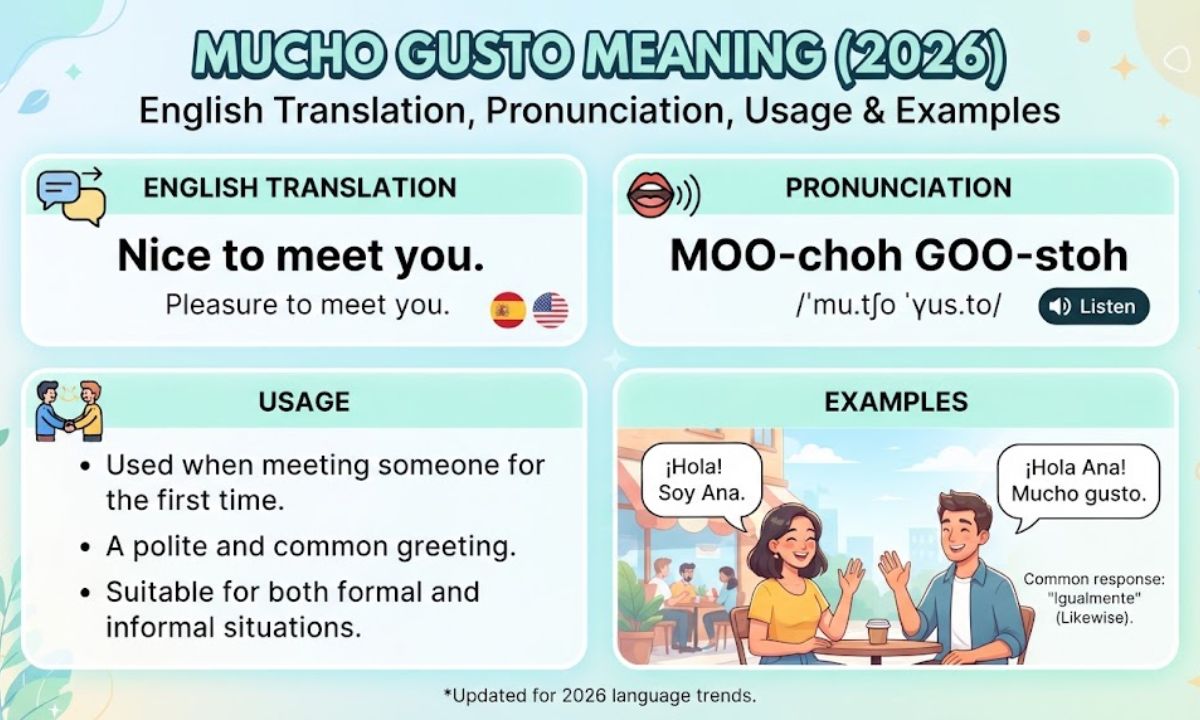
Mucho gusto is a common Spanish greeting used when meeting someone for the first time. In English, it translates most naturally to “nice to meet you” or “pleased to meet you.” It can also be understood as “it’s a pleasure” or “how do you do,” depending on the setting.
The phrase doesn’t change based on gender or number. Whether you’re speaking to a man, a woman, or a group of people, “mucho gusto” stays exactly the same. This makes it one of the simplest and most reliable Spanish phrases for beginners to memorize.
Breaking It Down Word by Word
To fully understand the phrase, it helps to look at each word separately.
| Word | Literal Meaning | Role in the Phrase |
| Mucho | Much / a lot | Acts as an intensifier |
| Gusto | Pleasure / liking | The core noun expressing delight |
Put together, “mucho gusto” literally means “much pleasure.” While that sounds unusual in English, it works beautifully in Spanish as a way to express genuine delight at meeting someone.
Meaning of Mucho Gusto in Spanish Culture
In Spanish-speaking cultures, first impressions matter, and language plays a big role in showing respect. Saying “mucho gusto” isn’t just a formality — it signals warmth, politeness, and genuine interest in the person you’re meeting.
Using this phrase correctly can:
- Show cultural awareness and respect
- Help break the ice in social or business settings
- Create an immediate sense of friendliness
- Set a positive tone for the rest of the conversation
Mucho Gusto — Which Language?
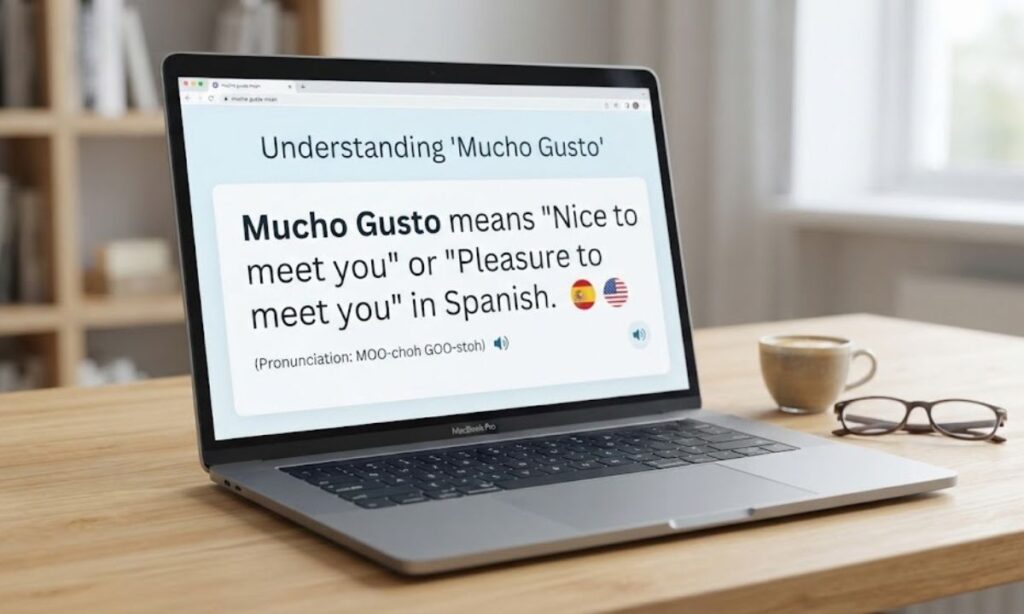
Mucho gusto is a Spanish phrase, used across nearly every Spanish-speaking country, including Mexico, Spain, and most of Latin America. It is not French, Italian, or Portuguese, though learners sometimes confuse it with similar-sounding phrases in those languages. The words themselves — “mucho” and “gusto” — are purely Spanish in origin.
When to Use “Mucho Gusto” in Real Life
Mucho gusto is best used in these situations:
- Meeting someone for the very first time
- Being introduced to a new colleague or business contact
- Greeting someone at a social event or party
- Responding after someone tells you their name
It is not used as a farewell. Once you’ve already met someone, you wouldn’t say it again in later conversations — it’s strictly an introduction phrase.
Spanish Introduction Phrases Beyond Mucho Gusto
While “mucho gusto” is popular, it isn’t the only way to greet someone new in Spanish. Depending on the setting, native speakers often mix in other phrases.
Formal Spanish Greetings for Introductions
- Es un placer conocerlo/la — “It’s a pleasure to meet you”
- Encantado/Encantada de conocerle — “Delighted to meet you”
- ¿Cómo está usted? — “How are you?” (formal)
Informal Spanish Greetings for Introductions
- ¡Qué gusto conocerte! — “So great to meet you!”
- Encantado/Encantada — “Delighted” (shortened, casual version)
- ¿Qué tal? — “What’s up?” or “How’s it going?”
Encantado vs Mucho Gusto: What ‘s the Real Difference?
Both phrases are used when meeting someone, but there’s a small distinction worth knowing.
| Phrase | Meaning | Gender Agreement | Common Usage |
| Mucho gusto | Nice to meet you | Stays the same for everyone | Widely used, neutral tone |
| Encantado/Encantada | Delighted (to meet you) | Changes based on speaker’s gender | Slightly more formal or heartfelt |
A man would say “encantado,” while a woman would say “encantada.” Mucho gusto avoids that complexity entirely, which is part of why it’s so popular with learners.
How to Say “Nice to Meet You” in Spanish (All Natural Options)
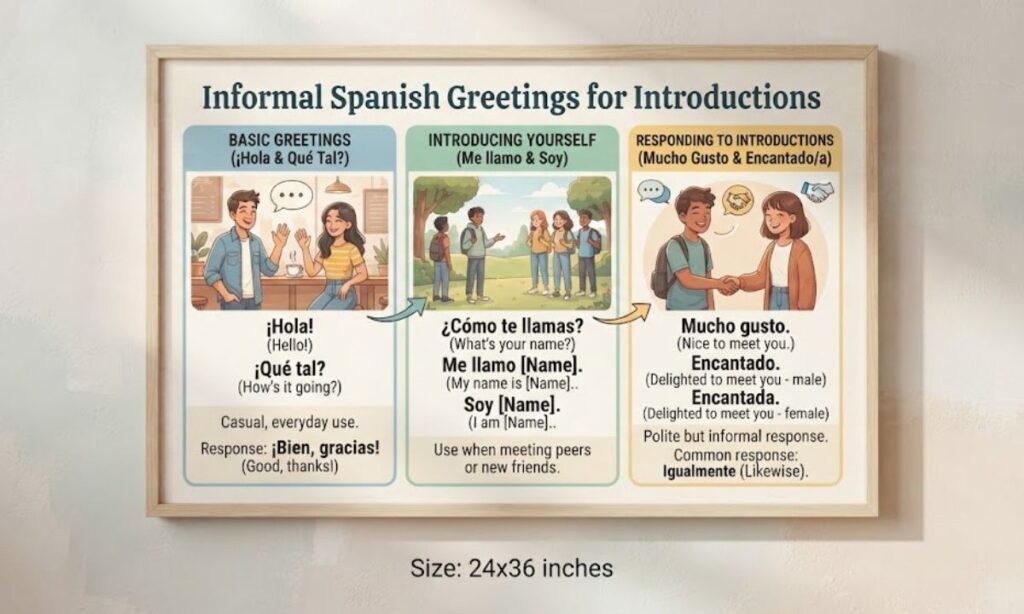
Here are several natural ways to express the same sentiment:
- Mucho gusto
- Encantado / Encantada
- Es un placer conocerte
- Un placer
- Qué alegría conocerte
Each option carries a slightly different tone, but all are appropriate for introductions.
Also read this meaning of perform vs perform
Mucho Gusto Response: What to Say Back
When someone says “mucho gusto” to you, it’s polite to respond in kind. You don’t need to overthink it — a short, warm reply is enough.
Mucho Gusto Response Table
| They Say | You Can Reply | English Meaning |
| Mucho gusto | Igualmente | Likewise |
| Mucho gusto | El gusto es mío | The pleasure is mine |
| Mucho gusto | Mucho gusto también | Nice to meet you too |
| Mucho gusto | Encantado/Encantada | Delighted (as a reply) |
Conversation Examples for Real Situations
Seeing the phrase in context makes it much easier to remember. Here are three common situations.
Business Meeting (Business Spanish Etiquette)
Ana: Buenos días, soy Ana, la gerente de proyectos. Carlos: Mucho gusto, Ana. Soy Carlos, del equipo de ventas. Ana: El gusto es mío, Carlos.
Casual Introduction
Sofia: Hola, soy Sofia. Miguel: ¡Mucho gusto, Sofia! Yo soy Miguel. Sofia: Igualmente, Miguel.
Networking Event
Laura: Hola, mi nombre es Laura, trabajo en marketing. Diego: Mucho gusto, Laura. Diego, encantado de conocerte. Laura: Mucho gusto también, Diego.
Pronunciation Guide: Say It Like a Native
Spanish pronunciation is fairly consistent once you learn the basic sounds. Here’s how to say it correctly.
- Mucho — pronounced “MOO-choh”
- Gusto — pronounced “GOO-stoh”
Stress falls on the first syllable of each word. A simple way to remember it: think of the word “moo” (like a cow) followed by “goo” (like glue), with a soft “-choh” and “-stoh” ending.
What Does “Con Mucho Gusto” Mean in English?
Adding “con” (meaning “with”) changes the phrase slightly. “Con mucho gusto” translates to “with great pleasure” or “gladly.” It’s commonly used as a warm, enthusiastic way to agree to a request.
Example: “¿Puedes ayudarme?” (Can you help me?) “Sí, con mucho gusto.” (Yes, with great pleasure.)
This version isn’t used for introductions — it’s used to express willingness or enthusiasm when agreeing to do something for someone.
Gusto Meaning in Spanish: The Root of It All
On its own, “gusto” means “taste,” “liking,” or “pleasure.” It’s related to the verb “gustar,” which means “to like” or “to be pleasing to.” Understanding this root word helps explain why “mucho gusto” carries such a warm, positive tone — it’s literally expressing a strong sense of pleasure or delight.
Cultural Nuances: Spain Spanish Customs vs Latin American Spanish

While “mucho gusto” is understood everywhere Spanish is spoken, the way people use it can vary slightly by region.
Spain Spanish Customs
- Often paired with a light cheek kiss or handshake, depending on formality
- “Encantado/Encantada” is used just as often as “mucho gusto”
- Slightly more common in formal or professional introductions
Latin American Spanish
- “Mucho gusto” is extremely common in everyday introductions
- In Costa Rica specifically, it can also be used to mean “you’re welcome”
- Often accompanied by a handshake, especially in business settings
Cultural Nuances to Remember
- Eye contact and a smile matter as much as the words themselves
- A firm handshake is standard in most Spanish-speaking business settings
- Overusing the phrase in repeated meetings can come across as unnatural
English Equivalents: Why Translation Isn’t Perfect
Direct translation rarely captures the full feeling of a phrase. “Much pleasure” sounds stiff and outdated in English, which is why native English speakers say “nice to meet you” instead. Spanish, however, embraces this expressive style naturally, showing how language reflects culture, not just vocabulary.
Formal vs Informal Greetings: Quick Reference
| Situation | Recommended Phrase |
| Business meeting | Es un placer conocerlo/la |
| Casual meetup | Mucho gusto |
| Formal introduction | Encantado/Encantada |
| Networking event | Mucho gusto |
| Friendly gathering | ¡Qué gusto conocerte! |
Business Spanish Etiquette: First Impressions Matter
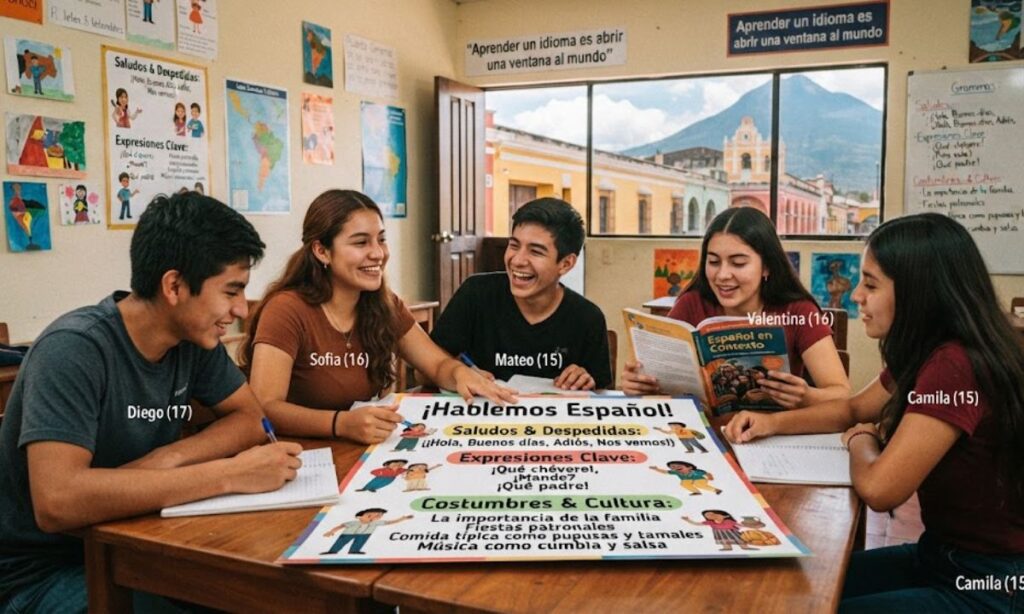
In professional settings, how you introduce yourself can shape the entire relationship. A confident “mucho gusto,” paired with a firm handshake and direct eye contact, signals professionalism and respect. Avoid rushing through the greeting — take a moment to make the introduction feel genuine.
Social Interactions Beyond the Words
Language is only part of a good first impression. Body language, tone of voice, and timing all play a role. A warm smile, a steady handshake, and a relaxed tone can make “mucho gusto” feel far more sincere than the words alone.
Common Mistakes to Avoid
- Translating it too literally. Saying “much pleasure” in English sounds awkward — stick to “nice to meet you.”
- Using it as a goodbye. It’s strictly for introductions, not farewells.
- Overusing it. Saying it every time you see the same person can feel robotic.
- Forgetting to respond. Leaving the phrase unanswered can seem impolite.
Case Study: How One Phrase Builds Connection
Consider a business traveler meeting a client in Mexico for the first time. Instead of a generic “hello,” they say, “Mucho gusto, señor Ramírez.” The client immediately notices the effort and warms up to the conversation. That small phrase — just two words — helps build trust before a single business topic is even discussed. It’s a simple example of how language can shape relationships from the very first sentence.
“Mucho Gusto” in Songs and Pop Culture
Many searches come from people who heard the phrase in a song, TV show, or movie and want to know what it means. Mentioning a well-known cultural reference (without quoting lyrics) can capture curious searchers who aren’t language learners at all.
“Mucho Gusto” Tattoo Meaning
Surprisingly, a decent number of people search this before getting a small phrase tattoo. A short note on the literal meaning and why it’s a popular choice for travel or connection-themed tattoos could pick up this niche traffic.
“Mucho Gusto” vs “Nice to Meet You” — Direct Comparison
People often search for this exact comparison phrase. A short section directly contrasting the literal vs. natural translation (which you already partly cover) tends to rank well as a standalone featured snippet target.
How to Reply to “Mucho Gusto” in a Text Message
A growing number of searches are about replying in texting or DM contexts specifically, not spoken conversation. A quick line on casual texting replies (like “Igual! 😊”) can capture this modern search intent.
“Mucho Gusto” Meaning in Different Spanish-Speaking Countries
Beyond Spain vs. Latin America, specific country searches (Mexico, Argentina, Colombia) get decent individual volume. Even one line noting country-specific quirks (like the Costa Rica “you’re welcome” usage you already have) helps capture these long-tail searches.
Duolingo / Language App Related Searches
A lot of traffic comes from people learning the phrase through apps like Duolingo and searching to double check the meaning. A short FAQ like “Why does Duolingo teach mucho gusto?” could realistically capture featured snippet space.
Quick Reference Summary Table
| Term | Meaning | Best Used For |
| Mucho gusto | Nice to meet you | First-time introductions |
| Con mucho gusto | With great pleasure / gladly | Agreeing to a request |
| Encantado/Encantada | Delighted to meet you | Formal introductions |
| Igualmente | Likewise | Responding to a greeting |
| El gusto es mío | The pleasure is mine | Polite response |
Frequently Asked Questions
What does “mucho gusto” mean in English?
It means “nice to meet you” or “pleased to meet you,” used when meeting someone for the first time.
How do you pronounce “mucho gusto”?
It’s pronounced “MOO-choh GOO-stoh,” with stress on the first syllable of each word.
What does “con mucho gusto” mean in English?
It means “with great pleasure” or “gladly,” typically used when agreeing to help with something.
Is “mucho gusto” formal o informal?
It works in both formal and informal situations, making it one of the most versatile Spanish greetings.
What is the difference between “mucho gusto” and “encantado”?
“Mucho gusto” stays the same for everyone, while “encantado” or “encantada” changes based on the speaker’s gender.
How do you respond to “mucho gusto”?
Common replies include “igualmente” (likewise) or “el gusto es mío” (the pleasure is mine).
Can “mucho gusto” be used to say goodbye?
No, it’s only used for introductions, not for farewells.
Final Thoughts on Mucho Gusto Meaning
“Mucho gusto” may be just two words, but it carries real cultural weight. It’s more than a translation exercise — it’s a small gesture of respect and warmth that can shape how someone perceives you from the very first moment you meet. Whether you’re traveling, working with international clients, or simply learning Spanish, mastering this phrase — and knowing how to respond to it — is a simple step that makes a lasting impression.
