
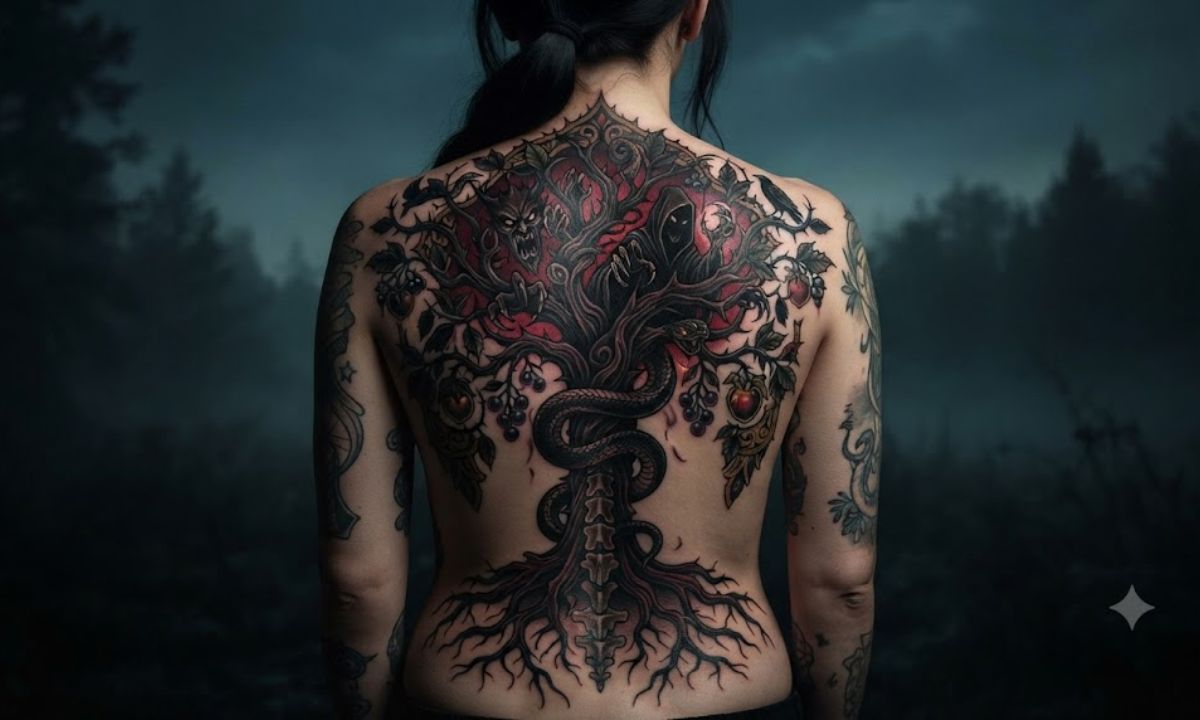

A poison tree tattoo is one of the most quietly powerful designs in modern ink culture. It looks simple at first glance — a tree, sometimes fruit, sometimes a snake — but underneath that image sits centuries of poetry, psychology, and personal history.
If you’ve been searching for the real poison tree tattoo meaning, you’re likely drawn to it for a reason. Maybe you’ve lived through a betrayal. Maybe you’ve swallowed anger instead of speaking it. Or maybe the imagery just struck something in you before you even knew why.
This guide breaks down everything: the literary origin, the core symbolism, the most popular design styles, color meanings, placement ideas, and the psychology behind why this tattoo resonates so deeply with people today.
What Is a Poison Tree Tattoo?
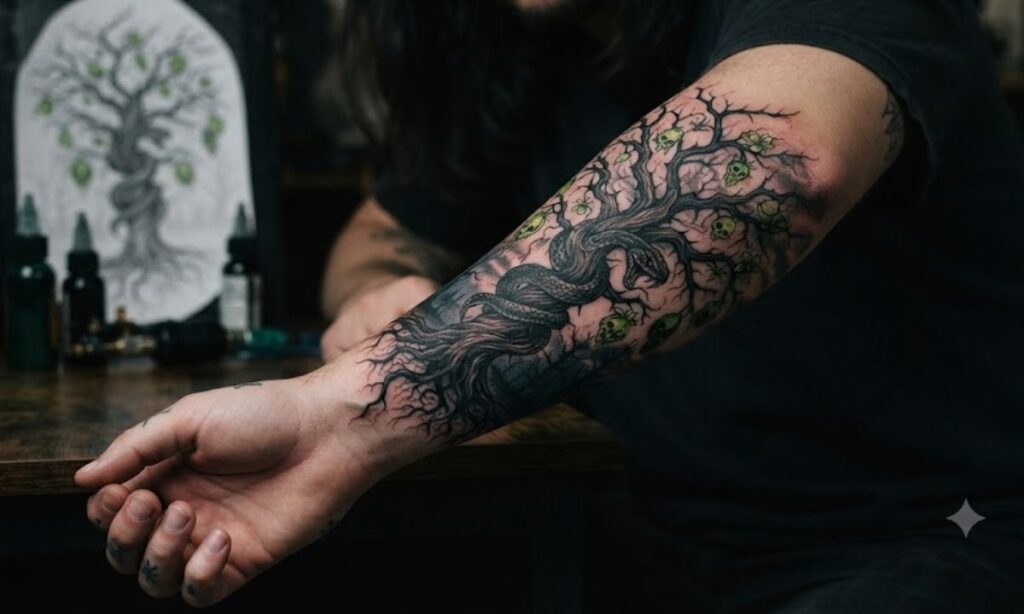
A poison tree tattoo is a design centered around a tree — often twisted, dark-barked, or half-withered — that produces fruit associated with danger rather than nourishment. Instead of representing life and growth in the traditional sense, this tree represents what happens when negative emotions are left to grow unchecked.
It’s not a generic “nature tattoo.” Most people who choose this design know exactly what it stands for: buried anger, hidden resentment, or emotional pain that was never given a voice.
Common visual elements include:
- A tree with dark, twisted branches
- Glossy or glowing fruit hanging from the limbs
- A serpent coiled around the trunk
- Roots that dig deep into the ground
- A contrast between healthy and decaying sections of the tree
The Origins: William Blake’s “A Poison Tree” (1794)
The poison tree tattoo traces directly back to English poet William Blake, who published A Poison Tree in 1794 as part of his collection Songs of Experience.
The poem tells a short but striking story. The narrator feels anger toward a friend, expresses it, and the anger fades. Then he feels anger toward an enemy, but this time he stays silent. Instead of speaking his wrath, he nurtures it in secret — feeding it with false smiles and quiet resentment — until it grows into a tree that produces a single, tempting piece of fruit. His enemy eventually takes the fruit, with fatal consequences.
Blake wasn’t writing about literal poison or literal murder. He was writing about what unspoken anger does to a person over time — how silence doesn’t make resentment disappear, it just gives it room to grow.
This is why the poison tree tattoo meaning is so tightly linked to emotional suppression. It’s less about the tree itself and more about the choice to bury feelings instead of expressing them.
Poison Tree Tattoo Meaning: Core Symbolism
At its heart, this tattoo carries a few consistent themes across almost every design variation:
| Symbol | Meaning |
| The tree | Growth of hidden emotion over time |
| The fruit | The final, dangerous result of buried anger |
| The roots | How deeply resentment can take hold |
| The serpent | Temptation, betrayal, or deceit |
| Withered branches | Emotional damage or decay |
| New leaves or blossoms | Healing and self-awareness after pain |
Broadly, people connect the design to:
- Suppressed anger – emotions bottled up instead of expressed
- Toxic relationships – surviving or leaving a harmful connection
- Warning symbolism – a reminder not to let resentment fester
- Emotional honesty – choosing to speak instead of stay silent
- Transformation and healing – growth that comes after acknowledging pain
Who Gets a Poison Tree Tattoo — and Why
This tattoo tends to appeal to a specific kind of person: someone reflective, often literary-minded, who has been through an emotional experience worth marking permanently.
People commonly choose this design after:
- Ending a toxic or manipulative relationship
- Working through unresolved anger or grief
- Wanting a personal reminder to communicate instead of suppress
- Feeling a strong connection to Blake’s poetry or Romantic-era literature
- Completing a period of therapy, healing, or self-reflection
It’s rarely a spontaneous choice. Most wearers describe it as a symbol they “grew into” understanding, rather than one they picked because it looked cool.
Popular Design Variations
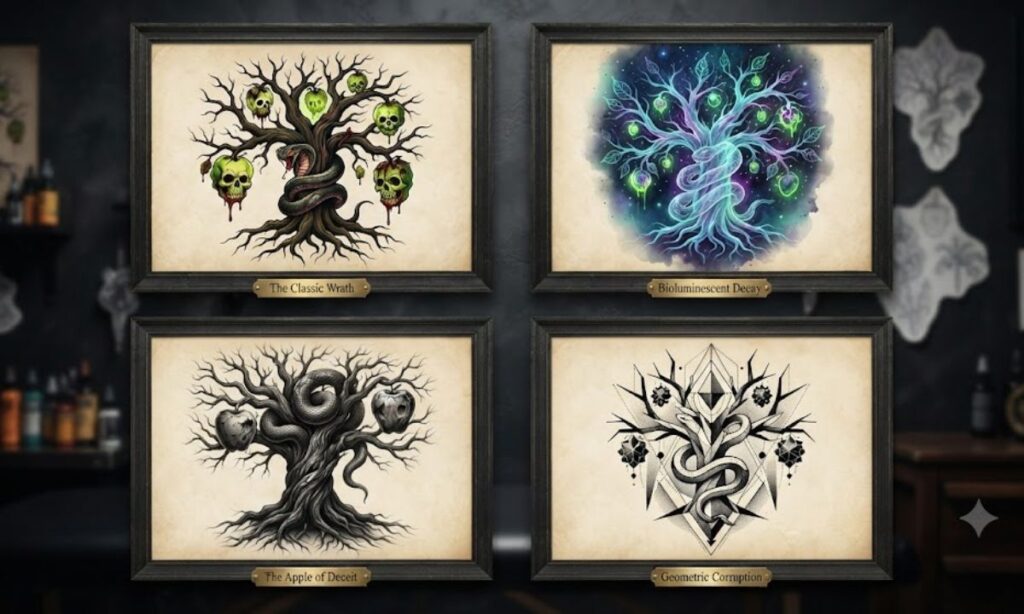
The poison tree tattoo isn’t one fixed image — it’s a concept that artists interpret in very different styles.
Black and Grey Gothic Style
Heavy shading, sharp bark textures, and a moody, almost haunted atmosphere. This style leans into the darker side of the symbolism.
Blake-Inspired Illustration
Designs that echo old engraving or etching styles, similar to the illustrations found in original 18th-century poetry collections.
Half-Dead, Half-Living Tree
One side of the tree is barren and cracked; the other is full of leaves or blossoms. This variation directly represents the balance between pain and healing.
Serpent and Fruit Motif
A snake wrapped around the trunk, often near the fruit, emphasizing temptation, deceit, or a specific betrayal.
Heartfruit Design
Instead of an apple, the tree bears fruit shaped like a heart — a more literal nod to emotional pain being the “fruit” of the tree.
Minimalist Line Art
A simple single-line tree, often small and placed discreetly, for people who want the meaning without heavy visual detail.
Watercolor Style
Soft, blended colors that soften the darker theme, often chosen by people who want the design to feel more like healing than warning.
ALSO READ THIS MEANING WYF MEANING
Color Meanings in Poison Tree Tattoos
Color choice can shift the emotional tone of the design significantly.
| Color | Common Meaning |
| Black | Suppressed anger, shadow, secrecy |
| Deep red | Passion, wrath, or unresolved conflict |
| Green | Growth, healing, renewal |
| Purple | Transformation, introspection |
| Gold or yellow accents | Hope or clarity after hardship |
| Grey/muted tones | Emotional numbness or quiet endurance |
Many people intentionally mix colors — dark roots with brighter leaves, for example — to show the journey from pain to healing within a single image.
Best Placement Options for a Poison Tree Tattoo
Placement often reflects how personal or visible someone wants the meaning to be.
- Forearm – visible, popular for detailed line work
- Upper arm or shoulder – enough space for a full tree with branches and roots
- Back – ideal for large, highly detailed pieces with roots and full canopy
- Ribcage – a more private placement, chosen by those who want the meaning kept personal
- Calf or thigh – good space for vertical tree designs
- Behind the ear or wrist – minimalist versions for a subtle reminder
Psychological Dimension: Why This Symbol Resonates So Deeply
Beyond the literary roots, the poison tree tattoo taps into something universally human: the experience of holding something in until it grows bigger than it needed to be.
Psychologically, the design resonates because it visualizes an internal process most people recognize — the slow build-up of resentment, the discomfort of unspoken conflict, and the relief (or damage) that comes after finally confronting it.
For many wearers, getting this tattoo isn’t about celebrating anger. It’s about acknowledging it, naming it, and choosing not to let it quietly take root again. That act of self-awareness is often the real meaning behind the ink — not the poem itself, but the personal decision to stop feeding what hurts.
Conclusion
The poison tree tattoo’s meaning goes far beyond dark aesthetics. Rooted in William Blake’s 1794 poem, it captures a deeply human truth: emotions we refuse to express don’t vanish — they grow. Whether someone chooses this design to mark healing, to process betrayal, or simply to honor a piece of literature that changed how they see anger, the symbol carries real emotional weight.
If you’re considering this tattoo, take time to decide which version of the meaning fits your story — the anger, the warning, or the healing that comes after. That personal connection is what turns a striking design into a truly meaningful one.
FAQs
What does a poison tree tattoo mean?
It typically symbolizes suppressed anger or emotional pain that grows over time when left unexpressed, based on William Blake’s poem A Poison Tree.
Is the poison tree tattoo based on a real poem?
Yes, it’s inspired by William Blake’s 1794 poem A Poison Tree, published in his collection Songs of Experience.
Is a poison tree tattoo a negative symbol?
Not necessarily — many people use it as a symbol of healing, self-awareness, or overcoming a toxic relationship rather than pure negativity.
What does the fruit represent in the design?
The fruit represents the final, often destructive result of nurturing hidden anger or resentment instead of expressing it.
Where is the most popular placement for this tattoo?
Forearms, upper arms, and the back are the most popular spots due to the space needed for tree branches and roots.
