


Laptop Adviser Expert Gaming
Choosing a gaming laptop in 2026 is harder than ever. Every brand claims top-tier performance, every spec sheet looks impressive, and every ad promises the “ultimate gaming experience.” But real-world performance often tells a different story. That’s where review platforms like TheLaptop Adviser Meaning come in — offering detailed, benchmark-based evaluations instead of surface-level spec summaries.
This article breaks down how The Laptop Adviser tests Expert gaming laptops, how accurate its reviews really are, and how you can use its ratings to make a smarter buying decision.
What Is TheLaptopAdviser?
TheLaptopAdviser is a review-focused platform built around one core idea: real performance matters more than marketing claims. Rather than repeating manufacturer specifications, it runs laptops through practical gaming and workload scenarios to see how they actually behave under pressure.
The platform covers multiple laptop categories, including:
- Gaming laptops (budget, mid-range, and flagship)
- Creator and content-production laptops
- Business and ultrabook models
- Workstation-class devices
Each category is evaluated on its own terms. A budget gaming laptop isn’t compared against a flagship rig — it’s scored against similar devices in its price tier, which gives buyers realistic expectations instead of misleading comparisons.
How TheLaptopAdviser Tests Gaming Laptops

Good reviews aren’t built on first impressions. TheLaptopAdviser’s testing process focuses on sustained, repeatable results rather than one-time benchmark runs.
The core testing areas typically include:
- Gaming performance – Frame rates across esports titles and AAA games at multiple settings.
- Thermal behavior – How much a laptop throttles after 30+ minutes of continuous gameplay.
- CPU and GPU stability – Whether performance holds steady or dips during long sessions.
- Storage and RAM responsiveness – Load times and multitasking performance under stress.
- Battery endurance – Real-world drain rates, which often differ from manufacturer claims.
This approach matters because a laptop that scores well in a five-minute benchmark can still overheat and slow down during a two-hour Expert gaming session. Testing for sustained performance, not just peak numbers, is what separates a useful review from a promotional one.
Breaking Down the Scoring System
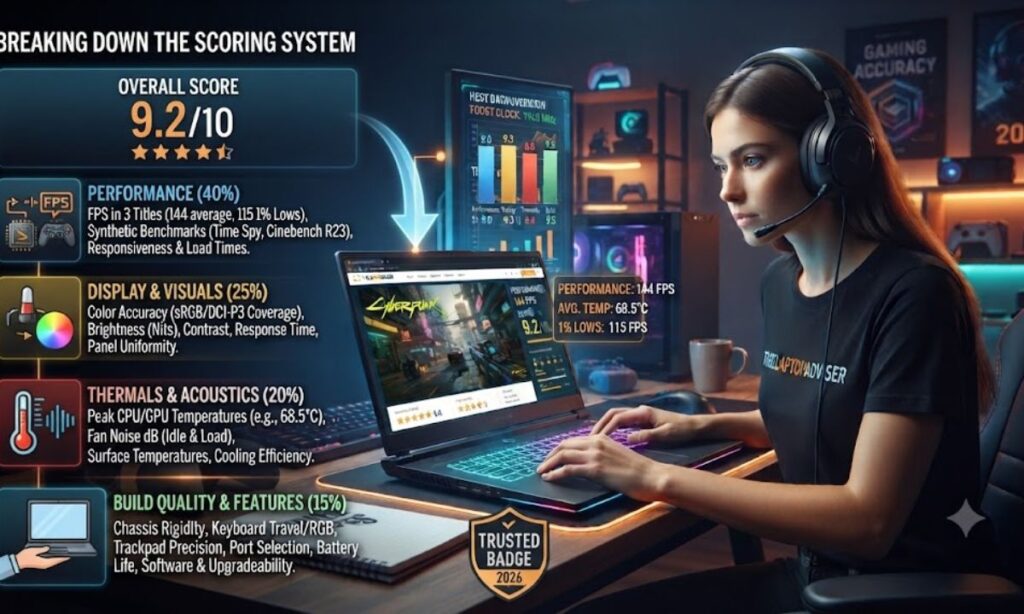
TheLaptopAdviser’s scoring model weighs multiple performance categories rather than relying on a single number. A simplified breakdown looks like this:
| Category | What It Measures | Why It Matters |
| Gaming Performance | Average FPS, 1% low FPS | Reveals real smoothness, not just peak speed |
| Cooling Efficiency | Thermal throttling after extended use | Prevents mid-session slowdowns |
| Build & Design | Materials, port selection, upgradeability | Affects long-term usability |
| Display Quality | Refresh rate, color accuracy, brightness | Impacts visual gaming experience |
| Battery Life | Real-world drain during gaming and daily use | Matters for portability |
| Value for Price | Performance relative to cost | Helps buyers compare tiers fairly |
Scores within each tier are relative — meaning a $900 laptop and a $2,500 laptop aren’t judged by identical standards, but both are judged fairly within their own price bracket.
The Laptop Adviser vs. the Competition
Here’s how TheLaptopAdviser generally compares to other well-known laptop review approaches:
| Feature | The Laptop Adviser | Typical Spec-Sheet Review Sites |
| Real gameplay testing | Yes, extended sessions | Often limited or absent |
| Thermal stress testing | Yes | Rarely detailed |
| Tier-based scoring | Yes | Sometimes inconsistent |
| Battery real-world testing | Yes | Often based on manufacturer claims |
| Beginner-friendly breakdowns | Yes | Varies widely |
The biggest differentiator is depth. Many sites summarize what’s already on a manufacturer’s product page. TheLaptopAdviser tries to go further by showing how a laptop behaves after the marketing gloss wears off.
Strengths Where The Laptop Adviser Gets It Right
- Transparency about weaknesses – Every laptop has trade-offs, and the reviews don’t hide them.
- Sustained performance focus – Long-session testing catches issues short benchmarks miss.
- Beginner accessibility – Complex data is broken down into simple, understandable takeaways.
- Regular updates – Reviews are refreshed as new GPUs and laptop models launch.
- Category-specific scoring – Fair comparisons within similar price ranges.
Where The Laptop Adviser Falls Short
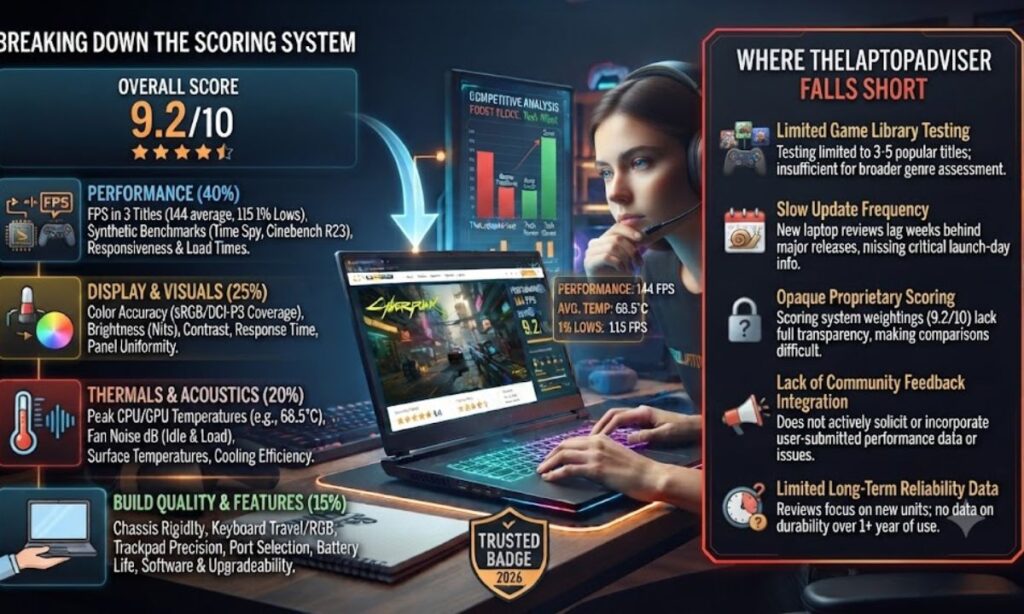
No review platform is perfect. A few limitations worth knowing:
- Testing conditions may vary between review cycles, which can slightly affect comparability.
- Not every model on the market gets reviewed, especially niche or regional releases.
- Scores can age quickly as new hardware generations arrive throughout the year.
- Subjective factors like keyboard feel or trackpad quality are harder to standardize than raw benchmark numbers.
Being aware of these gaps helps you use the reviews as one strong input, not the only one, in your buying decision.
How Accurate Are the Benchmarks, Really?
Benchmark accuracy depends on consistency. The most trustworthy review platforms:
- Test the same games and settings across multiple laptops
- Repeat tests rather than relying on a single run
- Measure both average FPS and 1% low FPS (the dips that cause stutter)
- Track temperature and clock speeds over time, not just at startup
TheLaptopAdviser’s methodology leans toward this structured, repeatable approach. That said, benchmarks are still a snapshot. Real-world results can shift slightly based on room temperature, software updates, or driver versions — so treat scores as a strong guide, not an absolute guarantee.
Also read this meaning poison tree tattoo meaning
What Actually Matters in 2026 Gaming Laptop Reviews
The gaming laptop landscape has shifted. Here’s what genuinely impacts performance this year:
- Processor tier – Intel Core Ultra HX and AMD Ryzen 9 HX chips lead the high-performance segment.
- RAM capacity – 16GB is now the minimum for serious gaming; 32GB is ideal for Expert gaming plus content creation.
- Cooling design – Often matters more than raw GPU power, since heat causes throttling.
- Display refresh rate – High refresh panels only help if the GPU can sustain matching frame rates.
- Storage speed – Faster SSDs reduce load times and improve multitasking.
Using These Reviews to Actually Make a Decision
Reading a review is only half the job. To use it effectively:
- Identify your budget tier first, then compare laptops within that tier only.
- Prioritize sustained performance scores over headline FPS numbers.
- Check cooling and thermal notes if you plan long gaming sessions.
- Cross-reference battery claims with real-world testing, not just spec sheets.
- Read both strengths and weaknesses before deciding — a laptop with one flaw might still be the right fit for your needs.
Common Mistakes Buyers Make
- Comparing laptops from different price tiers as if they’re equal
- Focusing only on peak FPS instead of consistency
- Ignoring cooling and noise levels until after purchase
- Trusting manufacturer battery claims without checking real-world tests
- Buying based on GPU name alone, without checking RAM or cooling
Quick Case Studies
Case 1: Budget Gamer A student buying a sub-$1,000 laptop should prioritize a Core i7 or Ryzen 7 with solid cooling over a slightly faster GPU that throttles under load.
Case 2: Competitive Esports Player Frame-rate consistency and a high refresh display matter more than raw graphical power for fast-paced titles like shooters.
Case 3: Content Creator Who Games 32GB RAM and strong sustained CPU performance matter more here than peak gaming FPS alone, since multitasking is a daily requirement.
A Practical Checklist for Evaluating Any Gaming Laptop Review
- ✅ Does it test sustained performance, not just short bursts?
- ✅ Does it measure thermal throttling after extended use?
- ✅ Does it separate budget, mid-range, and flagship comparisons?
- ✅ Does it disclose weaknesses honestly, not just strengths?
- ✅ Are battery claims tested in real conditions?
If a review checks most of these boxes, it’s likely trustworthy.
Final Verdict
TheLaptopAdviser offers a more thorough, honest approach than typical spec-sheet summaries. Its focus on sustained performance, thermal testing, and tier-based scoring gives buyers a clearer picture of real-world laptop behavior. It isn’t flawless — testing conditions and coverage can vary but for most shoppers, it’s a solid, reliable reference point.
Conclusion
Choosing a gaming laptop isn’t just about specs on paper anymore. Real performance, cooling, and consistency matter far more than marketing language. TheLaptopAdviser’s testing approach, built around sustained real-world performance, gives buyers practical insight they can actually use. Pair its reviews with your own priorities — budget, use case, and portability needs and you’ll be well equipped to make a confident decision.
Frequently Asked Questions
Is TheLaptopAdviser a reliable source for gaming laptop reviews?
Yes, it focuses on real-world, sustained performance testing rather than just spec sheets, which makes its reviews generally reliable.
Does TheLaptopAdviser test battery life accurately?
It measures real-world battery drain rather than relying only on manufacturer claims.
Are the reviews beginner-friendly?
Yes, complex benchmark data is broken down into simple, easy-to-understand takeaways.
How often are TheLaptopAdviser reviews updated?
Reviews are refreshed regularly as new laptops and GPUs enter the market.
Does TheLaptopAdviser compare budget and flagship laptops fairly?
Yes, laptops are scored within their own price tier rather than against unrelated categories.
What matters more — peak FPS or sustained FPS?
Sustained FPS matters more, since it reflects real gameplay smoothness over long sessions.
Can I trust benchmark scores completely?
Benchmarks are a strong guide but can vary slightly due to software updates or testing conditions, so use them alongside your own research.
